

2026 Ford Transit Work Van: Business Buyer’s Guide
A business buyer’s guide to the 2026 Ford Transit work van — series, roof heights, engines, and pricing — to help Kansas City contractors spec the right van for the job
A work van is a tool before it’s a vehicle, and the 2026 Ford Transit gives Kansas City businesses an unusually wide toolbox to choose from. Between three roof heights, two body lengths, four weight-rated series, two gas engines, and a fully electric option, the Transit can be built as a light-duty parts runner or a heavy-duty mobile shop — the trick is matching the build to the job instead of buying more van than the work requires, or too little to grow into.
Unlike a pickup, where trim level mostly changes comfort and tech, a Transit’s configuration changes what the van can physically carry and how it fits into a daily route. Get the roof height or payload rating wrong and you’re either stooping over every time you load a shelf, or turning away jobs because the van is maxed out before the crew is. At Rob Sight Ford, our commercial team specs Transit vans for Kansas City contractors, tradespeople, and delivery fleets every week, matching series and engine to the actual duty cycle. Start by reviewing our full 2026 Ford Transit cargo van configuration breakdown, then use this guide to build the case for the series and options that fit your business.
Key Takeaways
- The 2026 Transit Cargo Van lineup spans four series — 150, 250, 350, and 350 HD — in low, medium, or high roof heights on a regular or long wheelbase.
- Pricing starts around $50,495 for a low-roof Transit 150, with the electric E-Transit starting near $55,355 — both before destination and options.
- The standard 3.5L V6 makes 275 hp and 262 lb-ft; the available 3.5L EcoBoost V6 steps up to 310 hp and 400 lb-ft for heavier loads and trailering.
- Payload runs from up to 3,680 lbs on a Transit 150 to up to 5,114 lbs on a 350 HD, with cargo volume topping out near 487.3 cu. ft. on a high-roof, long-wheelbase build.
- Intelligent AWD is available on most low- and medium-roof gas configurations; the 350 HD adds dual rear wheels (DRW) instead, and the two aren’t offered together.
- Eligible 2026 Transit vans may qualify for a Ford Pro Telematics trial and, for many business buyers, Section 179 tax deductions worth factoring in before comparing sticker prices.
Transit Work Van Lineup — At a Glance
Transit 150 Starting: ~$50,495 | Transit 350 HD Starting: ~$54,000 | Series: 4 + E-Transit | Max Torque: 400 lb-ft
Understanding the 2026 Ford Transit Work Van Lineup
Ford doesn’t sell the Transit Cargo Van in XL-through-Platinum trims the way it does the F-150 or Super Duty. Instead, the lineup is organized by series — 150, 250, 350, and 350 HD — each carrying a different gross vehicle weight rating and payload ceiling on top of the same cab, the same base engine, and the same menu of roof heights and lengths. Think of series as the load rating you’re buying, not a comfort tier.
Layered on top of series, buyers choose a roof height, a body length, a drivetrain, and an engine — which means two Transits with the same series badge can look and drive completely differently. Here’s how the four series stack up before roof height, length, or engine are factored in:
| Series | Starting MSRP* | Max Payload | Best For |
|---|---|---|---|
| Transit 150 | ~$50,495 | Up to 3,680 lbs | Light parts runs, small service businesses |
| Transit 250 | ~$51,800 | Up to 4,080 lbs | Everyday contractor and trade vans |
| Transit 350 | ~$53,000 | Up to 4,480 lbs | Heavier tools, materials, and trailering |
| Transit 350 HD | ~$54,000 | Up to 5,114 lbs | Maximum-payload fleets and dual rear wheel needs |
*Starting MSRP figures are approximate, exclude destination and options, and vary by roof height, body length, engine, and drivetrain — always confirm current pricing with our commercial team.
Why Series Choice Shapes Your Van’s Total Cost
Moving up a series doesn’t change how the Transit looks or feels to drive — it changes what it’s rated to carry. A business that never loads past 3,500 lbs gains little from paying for a 350 HD’s extra capacity, while a business that regularly tops out a Transit 150 is really paying twice: once for a van that can’t do the job, and again for the repair bills that come from overloading it. The right series is the one that matches your heaviest realistic day, not your lightest one.
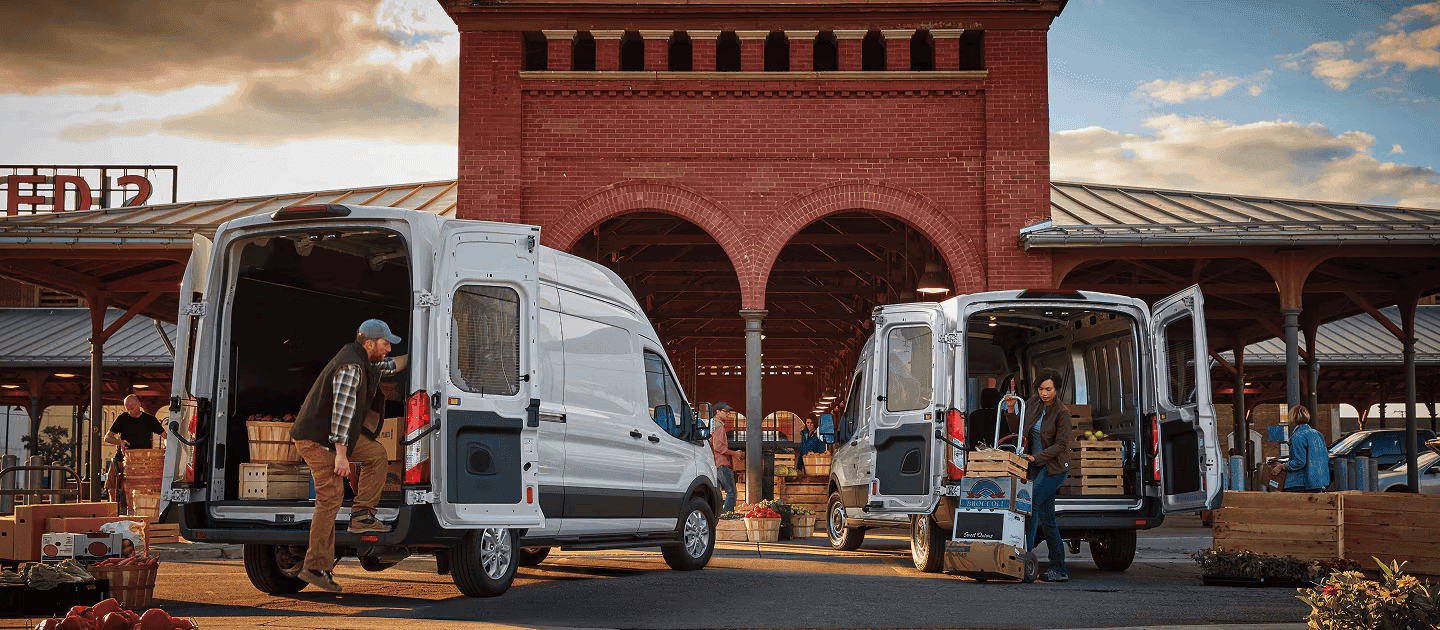
The 2026 Transit lineup runs from the light-duty 150 through the heavy-payload 350 HD. Rob Sight Ford stocks multiple series and configurations for Kansas City businesses to compare side by side.
Engines and Powertrains: What Pairs With What
Every 2026 Transit Cargo Van starts with the same standard 3.5L V6, with the turbocharged EcoBoost V6 available across nearly every low- and medium-roof, rear-wheel-drive configuration — no longer limited to a narrow options list the way it was in prior model years. Business buyers who also want to go electric can choose the E-Transit instead of either gas engine. All gas engines pair with a 10-speed automatic transmission.
3.5L V6 (Standard)
275 horsepower and 262 lb-ft of torque on regular fuel. Standard across the Transit 150, 250, and 350 — the value choice for vans that run light-to-moderate loads and prioritize lower fuel and purchase costs over outright power.
3.5L EcoBoost V6 (Available)
310 horsepower and 400 lb-ft of torque from a twin-turbo version of the same block. Standard on the Transit 350 HD and available on most other RWD gas builds — the upgrade for businesses that tow, run near max payload, or drive hilly routes.
E-Transit Electric Powertrain
A 266-horsepower electric motor drawing from an 89.9-kWh battery for up to 159 miles of estimated range. Best suited to predictable, return-to-base routes where overnight charging replaces a fuel stop entirely.
| Powertrain | Horsepower | Torque | Typical Availability |
|---|---|---|---|
| 3.5L V6 | 275 hp | 262 lb-ft | Standard: Transit 150, 250, 350 |
| 3.5L EcoBoost V6 | 310 hp | 400 lb-ft | Standard: 350 HD; Available: most RWD builds |
| E-Transit Electric | 266 hp | Instant | Standalone model, separate from gas series |
Because the EcoBoost V6 is available so widely, most buyers should choose series based on payload and roof height first, then decide on the engine based on how often the van tows or runs near its weight limit. For a deeper look at real-world fuel economy by engine and drivetrain, see our 2026 Ford Transit MPG guide covering RWD vs. AWD and roof height impact.
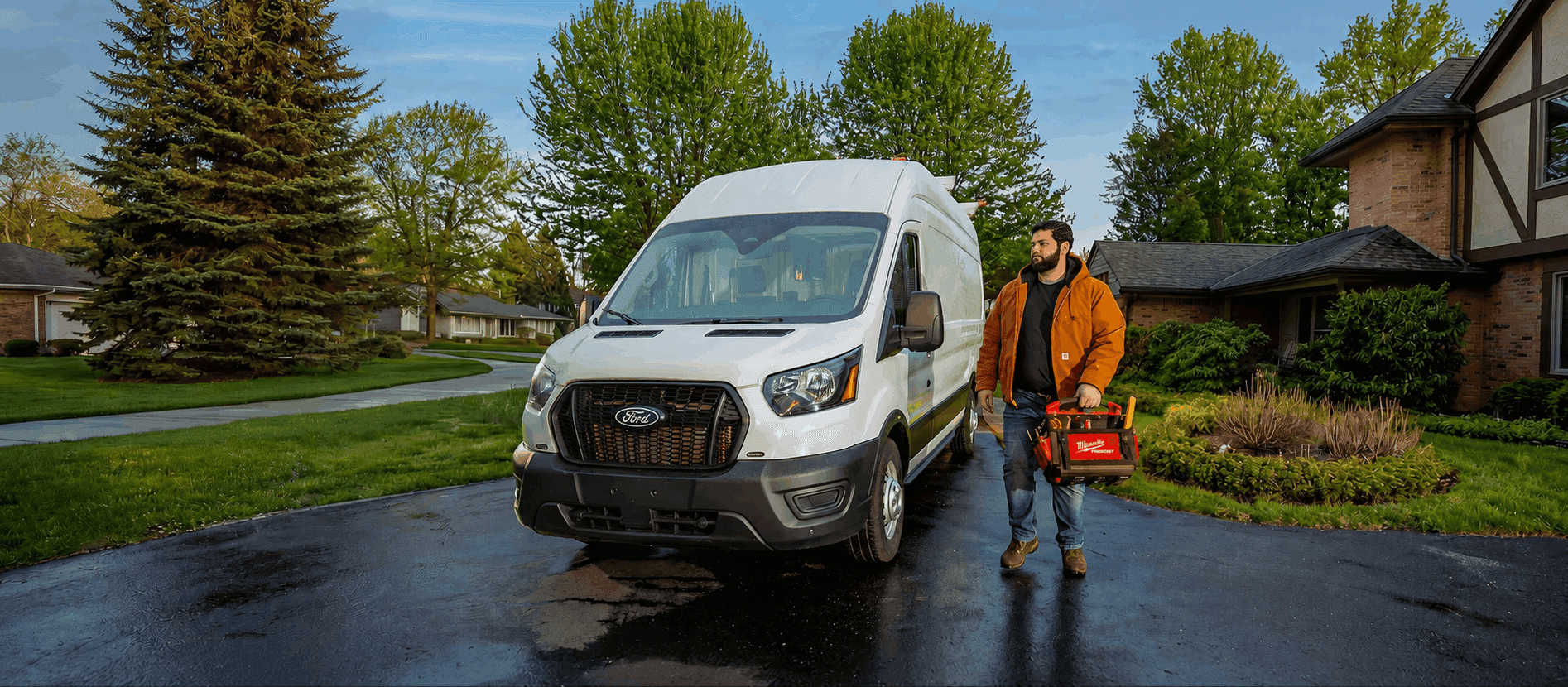
Engine and payload choice are largely independent of series on the 2026 Transit, so contractors can match power and capacity to the work without overbuying. Rob Sight Ford in Kansas City can help you spec the right combination.
Roof Heights & Body Lengths: Sizing the Van to the Job
Roof height and body length are the two decisions that shape how a Transit actually works day to day — far more than the series badge does. Low roof keeps the van garage-friendly and easiest to park, medium roof lets most adults stand up straight inside, and high roof maximizes cargo volume for businesses hauling bulky material. Length works the same way: regular wheelbase is easier to maneuver downtown, while the long wheelbase adds meaningful shelving and floor space.
| Roof Height | Interior Standing Height | Best For |
|---|---|---|
| Low Roof | 56.9 in. | Garage-height parking, lowest overall height |
| Medium Roof | 72 in. (6’0″) | Standing room for most crews, everyday balance |
| High Roof | 81.5 in. (6’9″) | Maximum cargo volume, mobile workshop builds |
Does Drivetrain Depend on Series?
Rear-wheel drive is standard across the Transit lineup, and Intelligent All-Wheel Drive is available on most low- and medium-roof gas configurations for businesses that need better traction on snow or unpaved job sites. The one trade-off: dual rear wheels (DRW) on the Transit 350 HD boosts payload and stability for maximum loads, but it’s only offered with RWD — DRW and AWD aren’t available together on any Transit.
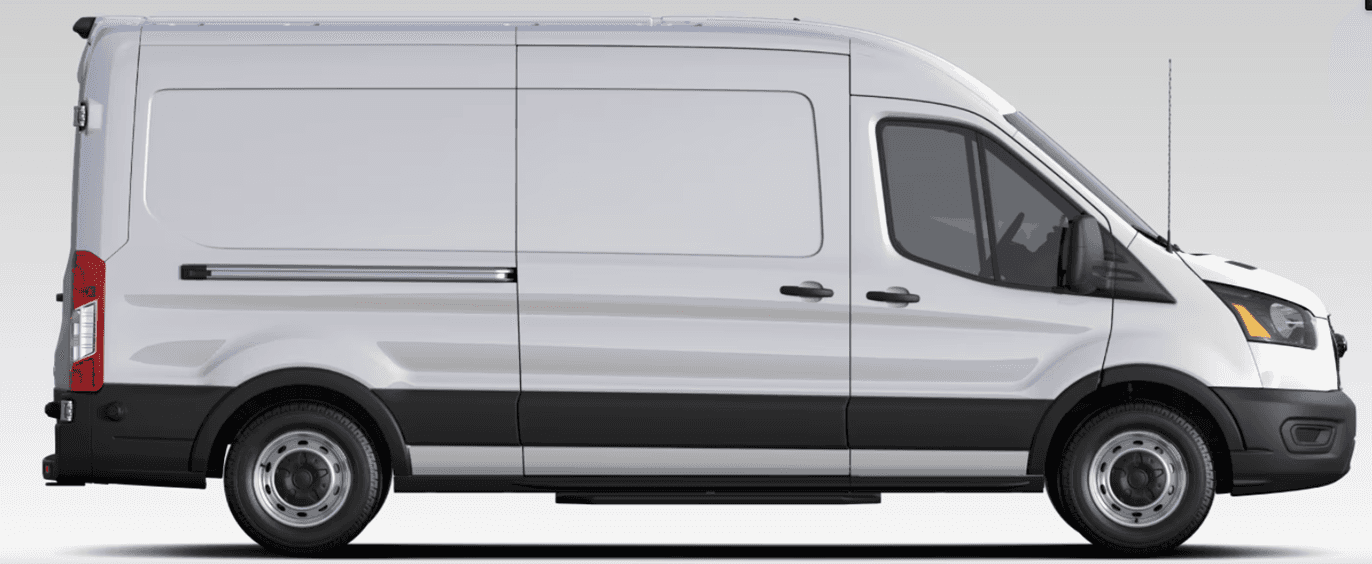
From low-roof parking-garage builds to high-roof mobile workshops, the 2026 Transit’s roof height and length options let Kansas City businesses size the van to the job. Rob Sight Ford stocks multiple configurations for side-by-side comparison.
Factors Beyond the Series Badge That Shape Your Decision
The Details That Shape Daily Ownership
Series and engine get the spec-sheet attention, but day-to-day ownership is shaped by how the cargo area is finished, how easily it upfits, and how the van holds its value on trade-in. These are the practical factors that often tip a close decision one way or the other:
Cargo Area & Upfitting
The durable vinyl floor and flat cargo walls are built to accept shelving, bins, and racking from day one. The Vehicle Integration System 2.0 pre-wires common upfitter connections, cutting install time and cost for ladder racks, partitions, and lighting.
Cabin Technology
SYNC 4 with a 12-inch touchscreen and a 5G modem supporting up to 10 connected devices come standard, keeping drivers connected without relying on a personal hotspot for dispatch or navigation apps.
GVWR & Configuration Overlap
Series sets the payload ceiling, but the number that matters on a specific build is the door-jamb GVWR rating — a well-optioned 250 can rival a lightly-optioned 350 in real-world capacity. Confirm the exact build’s rating before assuming series alone tells the whole story.
Resale & Total Cost
Medium-roof Transit 250 and 350 builds tend to hold value well because they suit the widest range of resale buyers. Highly specialized high-roof or heavy-duty builds can be harder to resell outside the fleet or upfitting market they were built for.
| Factor | Impact on the Decision | Guidance |
|---|---|---|
| Cargo & upfitting | Pre-wired connections speed up installs | Plan racking and partitions before ordering |
| Cabin technology | Standard SYNC 4 and 5G connectivity | Useful for dispatch, navigation, and driver accountability |
| GVWR & capability | Independent of series badge alone | Confirm the specific build’s door-jamb rating |
| Resale value | Mid-tier builds hold value best | Weigh specialized upfits against long-term resale |
Technology and Fleet Features That Earn Their Keep
Some of the Transit’s most useful business tools aren’t locked to a single series or roof height — several come standard or are widely available, which means a work van doesn’t have to be top-spec to run like one. Here’s what’s actually available and where it typically shows up:
Ford Pro Telematics
Connected fleet software adds GPS tracking, health alerts, and maintenance reminders across every van in a fleet. Eligible 2026 Transit models include a complimentary one-year trial, useful whether you run one van or ten.
Vehicle Integration System 2.0
Pre-wired auxiliary switches and power connections streamline upfitting for ladder racks, lighting, and equipment, reducing labor time and cost compared with aftermarket wiring.
Ford Co-Pilot360
Standard driver-assist features add a safety margin for a tall, long vehicle navigating tight job sites and city traffic — a benefit on every series, not just the heaviest-duty ones.
Remote Fleet Controls
Fleet-connected Transits support a remote acceleration limiter and fleet start inhibit, giving business owners more control over how and when each van is driven.
Because these tools are available across most of the lineup, don’t assume you need the heaviest-duty series just to get fleet management or driver-assist features. For a broader look at how Transit fits into Ford’s full commercial ecosystem alongside Super Duty and E-Series, see our Ford Pro commercial vehicle fleet buying guide for Kansas City businesses.
The Price Ladder — and What Each Step Costs to Run
Sticker price only tells part of the story for a work van — roof height, length, engine, and drivetrain all move the final number, and the engine choice also moves your fuel bill. Here’s the approximate price jump between series and what it buys, plus where the all-electric E-Transit lands by comparison:
| Series | Starting MSRP* | Jump from Previous | What You Gain |
|---|---|---|---|
| Transit 150 | ~$50,495 | — | Baseline work van |
| Transit 250 | ~$51,800 | ~$1,305 | Higher payload for everyday trade use |
| Transit 350 | ~$53,000 | ~$1,200 | More payload, EcoBoost V6 available |
| Transit 350 HD | ~$54,000 | ~$1,000 | Standard EcoBoost V6, DRW, max payload |
| E-Transit (Electric) | ~$55,355 | — | Zero tailpipe emissions, lower routine maintenance |
*Approximate figures before destination charge and options; actual pricing depends on roof height, length, engine, and drivetrain configuration.
Estimated Annual Fuel Cost by Typical Build (15,000 Miles/Year)
Because the Transit exceeds the threshold for EPA passenger-car fuel economy labeling on several configurations, real-world mileage is the more useful number for budgeting. The figures below use gas at $3.50/gal and reflect typical RWD vs. AWD differences:
| Typical Build | Est. Real-World MPG | Est. Annual Fuel Cost |
|---|---|---|
| Transit 150/250 — RWD, 3.5L V6 | ~15 mpg | ~$3,500 |
| Transit 350 — AWD, 3.5L V6 | ~13 mpg | ~$4,038 |
| Transit 350 HD — RWD, EcoBoost V6 | ~14 mpg | ~$3,750 |
The spread between series is smaller on fuel than it is on sticker price, which reinforces that payload and roof height — not engine alone — should drive the series decision. Business buyers should also note that many Ford Pro work vans, including the Transit, may qualify for meaningful first-year write-offs under Section 179 depending on gross vehicle weight and business use — worth discussing with your tax advisor before finalizing a build.
Making the Final Call: Which Transit Configuration Fits Your Business?
The cleanest way to decide is to think about what actually rides in the van on a normal day — not the one heaviest job it might do a few times a year. Match roof height and payload to your daily route and typical load, and the right build usually becomes obvious. Here’s how common Kansas City business scenarios map to the lineup:
| Business Scenario | Recommended Build | Why |
|---|---|---|
| Parts runner, light deliveries | Transit 150, low roof | Lowest cost, easiest to park and maneuver |
| Electrician, plumber, HVAC tech | Transit 250, medium roof | Standing room for shelving without the largest footprint |
| General contractor, heavier materials | Transit 350, medium or high roof | Extra payload and EcoBoost V6 availability |
| Mobile workshop, max payload fleet | Transit 350 HD, high roof | Standard EcoBoost V6 and dual rear wheel capacity |
| Fixed daily route, sustainability goals | E-Transit | Zero tailpipe emissions, lower routine maintenance |
If you’re still comparing the Transit against other work vans before committing, our 2026 Ford Transit vs. Mercedes Sprinter comparison breaks down payload, cargo volume, and total cost of ownership between the two.
Still on the fence? The fastest way to decide is to walk the cargo area of two or three configurations back to back. Our commercial team can set that up and help you spec the exact series, engine, and roof height for the work you do — so you buy once and buy right.
Tips for Choosing the Right Transit Work Van
A little discipline at order time keeps you from overspending on capacity you won’t use or underspending on payload you’ll wish you’d ordered. These tips apply whether you’re adding one van or building out a fleet:
Measure Your Heaviest Real Day
Add up the weight of tools, materials, and crew on your busiest realistic day — not a one-time move — before picking a series and payload rating.
Check the Garage and Route Before the Roof
A high roof adds standing room and cargo volume, but it also adds overall height — confirm it clears your garage, drive-thrus, and any parking structures on your regular route.
Plan Upfitting Before You Order
Shelving, partitions, and ladder racks are easier and cheaper to install when the build already accounts for them through Vehicle Integration System 2.0 wiring.
Weigh EcoBoost Against Your Fuel Bill
The EcoBoost V6 earns its cost quickly for vans that tow or run near max payload daily. For lighter routes, the standard V6’s lower fuel cost usually wins out over time.
Compare Every Transit Configuration at Rob Sight Ford in Kansas City
Whether you’re outfitting a single service van, replacing an aging fleet, or spec’ing an E-Transit for a fixed route, Rob Sight Ford in Kansas City has the Transit inventory and commercial expertise to help you choose with confidence. We serve businesses throughout the Kansas City metro — including Overland Park, Lee’s Summit, Grandview, and Blue Springs — and our commercial team is fluent in every Transit series, engine, and configuration available.
Call us at 816-895-6901, apply for financing before you arrive, or reach out to schedule a side-by-side configuration comparison.
Frequently Asked Questions
What are the 2026 Ford Transit work van configurations?
The 2026 Ford Transit Cargo Van lineup spans four series — 150, 250, 350, and 350 HD — built in low, medium, and high roof heights on a 129.9-inch regular wheelbase or a 147.6-inch long wheelbase. Combined with two gas engines and an all-electric E-Transit option, that adds up to dozens of possible builds, with pricing starting around $50,495 for a low-roof Transit 150 before options and destination.
What is the difference between the Ford Transit 150, 250, and 350?
The 150, 250, and 350 share the same cab, the same standard 3.5L V6, and the same roof and length choices — the difference is gross vehicle weight rating and payload. Payload climbs from up to 3,680 lbs on a Transit 150 to up to 4,080 lbs on a 250 and up to 4,480 lbs on a standard 350, with the heavy-duty 350 HD topping out near 5,114 lbs for buyers who regularly load the van to its limit.
Does the 2026 Ford Transit work van come with all-wheel drive?
Intelligent AWD is available across most low- and medium-roof gas Transit configurations on the Transit 150, 250, and 350, giving contractors better traction in snow and on job sites without pavement. The heaviest-duty Transit 350 HD trades that flexibility for dual rear wheels (DRW), which boosts payload and stability for maximum loads but is only offered with rear-wheel drive.
Which engine should I choose for a Ford Transit work van?
The standard naturally aspirated 3.5L V6 makes 275 horsepower and 262 lb-ft of torque and is the more fuel-efficient, lower-cost choice for vans that run light-to-moderate loads around town. The available 3.5L EcoBoost V6 adds twin turbos for 310 horsepower and 400 lb-ft of torque, which pays off for businesses that tow trailers, run at higher GVWR, or spend most of the day fully loaded.
Which Ford Transit configuration is best for a Kansas City contractor?
Most Kansas City contractors do well with a medium-roof, regular-wheelbase Transit 250 or 350 — tall enough to stand up inside, short enough to fit in a typical parking spot or garage, and rated for the tools and materials a service business actually carries. Businesses hauling heavier loads or pulling a trailer regularly should step up to the EcoBoost V6 and consider the extra payload of a 350 HD.
0 comment(s) so far on 2026 Ford Transit Work Van: Business Buyer’s Guide