

2026 Ford Transit MPG: RWD vs AWD, Roof Heights & Engine Options
Real-world MPG numbers by drivetrain, roof height, and engine — everything Kansas City fleet owners and van buyers need before choosing a 2026 Transit configuration
Does your choice of roof height really affect your fuel costs? The answer might surprise you — and for a fleet running 15,000+ miles a year, the difference between configurations could save your business thousands of dollars annually. The 2026 Ford Transit MPG numbers reveal more than a single rating. With three roof heights, three wheelbase options, two engine choices, and available all-wheel drive, two buyers can purchase the same Transit model and experience meaningfully different fuel costs every single month.
Real-world testing shows rear-wheel-drive Transit models reaching approximately 17 mpg on the highway, while all-wheel-drive versions average closer to 13 mpg in combined driving. That gap adds up fast. At Rob Sight Ford in Kansas City, our commercial team fields these questions daily — and whether you’re outfitting a delivery fleet or shopping a single cargo van, understanding which Ford Transit configuration fits your budget is where smart buying starts.
Key Takeaways
- The 2026 Ford Transit is exempt from federal EPA fuel economy standards, so independent testing provides the most reliable MPG data.
- Rear-wheel-drive models reach up to 17 mpg highway, while all-wheel-drive versions top out around 16 mpg highway and ~13 mpg combined.
- The 275-HP naturally aspirated 3.5L V-6 and the 310-HP EcoBoost twin-turbo V-6 deliver noticeably different real-world fuel economy.
- Roof height, wheelbase length, and payload weight all play a direct role in your Transit’s day-to-day fuel efficiency.
- A standard 10-speed automatic transmission helps both engines operate in their most efficient power bands at highway speeds.
- Choosing the right configuration can save fleet operators $400–$500 per vehicle per year in fuel costs compared to a less efficient setup.
2026 Ford Transit — At a Glance
RWD Highway MPG: 17 mpg | AWD Combined MPG: ~13 mpg | Max Tow Capacity: 6,900 lbs | Max Payload: 5,103 lbs
RWD Highway (75 mph)
AWD Combined (Real-World)
Base 3.5L V-6
EcoBoost Twin-Turbo V-6
Max Towing (EcoBoost)
Max Payload Capacity
Understanding the 2026 Ford Transit Lineup
Before exploring fuel economy numbers, it helps to understand exactly what makes each Transit different. The 2026 Transit is available as a cargo van or a passenger van, with panel vans, dropside builds, and double cab configurations rounding out the lineup. Each body style carries different base weights that directly affect how much fuel it burns. The cargo van seats two and maximizes interior volume, while passenger vans can accommodate up to 15 people — a significant weight difference that shows up immediately at the pump.
Ford also gives buyers three wheelbase lengths — Regular, Long (147.6-inch), and Extended — along with three roof height options. Each adds a different combination of cargo volume, aerodynamic drag, and curb weight. Together, these choices shape your real-world MPG before you even select an engine.
| Roof Height | Interior Height | Best For | Max Payload |
|---|---|---|---|
| Low Roof | Standard | Parking garages, compact loads, best aerodynamics | Up to 5,103 lbs |
| Medium Roof | Mid-height | Balanced cargo space and clearance | Up to 4,300 lbs |
| High Roof | 109.2 inches | Standing room, upfitting, shelving builds | Up to 3,060 lbs |
Why Configuration Matters for Fuel Economy
Taller roofs add invaluable cargo space for upfitted commercial builds, but they significantly increase aerodynamic drag — particularly at highway speeds above 65 mph. Similarly, a longer wheelbase means more interior volume but also more vehicle weight, which costs you more in city driving where the engine works harder on acceleration. Understanding these trade-offs before you spec a Transit is the difference between a configuration that fits your work and one that quietly inflates your monthly fuel budget.
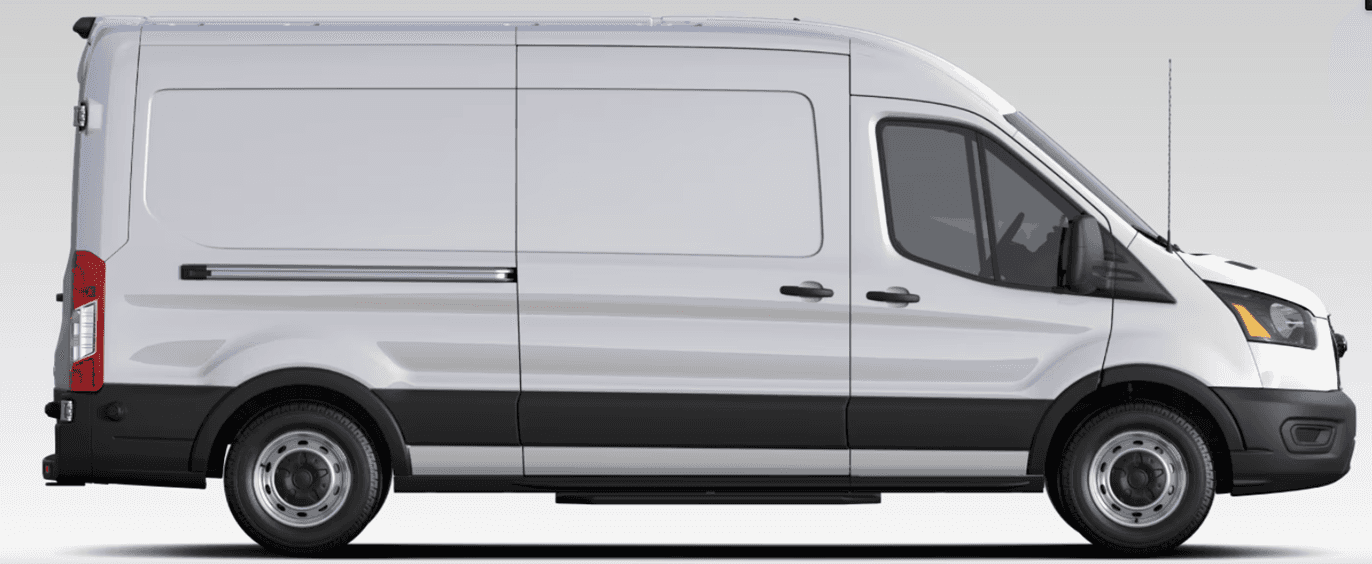
The 2026 Ford Transit is available in low, medium, and high-roof configurations — each affecting both cargo capacity and fuel economy. Rob Sight Ford in Kansas City stocks multiple Transit variants for test drives and side-by-side comparisons.
Engine Options and Their Impact on Fuel Economy
The 2026 Ford Transit comes with two gasoline V-6 engines, and the choice between them shapes both your daily fuel costs and your towing or hauling capability. One thing to note upfront: there is no diesel option for the 2026 Transit. Both engines pair with a standard 10-speed automatic transmission designed to keep the engine in its most efficient operating range as much as possible.
Naturally Aspirated 3.5L V-6 (Base)
275 horsepower and 262 lb-ft of torque. This engine prioritizes fuel economy over outright power, making it the stronger choice for lighter duty delivery routes, shuttle services, and fleets where payload rarely approaches maximum capacity.
EcoBoost Twin-Turbo 3.5L V-6
310 horsepower and 400 lb-ft of torque. Capable of 0–60 mph in approximately 6.7 seconds and towing up to 6,900 pounds, this engine is the right call for heavy loads, hilly terrain, or frequent towing — with a modest fuel economy trade-off.
10-Speed Automatic Transmission
Standard on both engines with no manual option. The extra gear ratios keep the engine in a narrower, more efficient RPM band on highway drives. The transmission also adapts to individual driving patterns over time for smoother, more fuel-conscious shifts.
No Diesel Option in 2026
Previous diesel Transit models earned mid-30s to low-40s MPG on some configurations, but Ford has discontinued diesel for 2026. Buyers comparing diesel van alternatives should factor in the $5,000–$10,000 higher upfront cost and the 10–20-year break-even timeline on fuel savings alone.
| Specification | 3.5L V-6 (Base) | 3.5L EcoBoost V-6 |
|---|---|---|
| Horsepower | 275 HP | 310 HP |
| Torque | 262 lb-ft | 400 lb-ft |
| 0–60 MPH | ~8.5 seconds | ~6.7 seconds |
| Max Towing Capacity | 5,100 lbs | 6,900 lbs |
| Transmission | 10-Speed Auto | 10-Speed Auto |
| Relative Fuel Efficiency | Higher (recommended for fuel savings) | Slightly Lower (better for heavy loads) |
For fleet operators whose vans run lighter loads on predictable daily routes, the base V-6 is the smarter long-term fuel choice. For contractors hauling tools and materials or businesses that tow trailers regularly, the EcoBoost’s extra torque justifies its modest fuel premium. Visit Rob Sight Ford’s commercial vehicles page to explore current Transit inventory with both engine options.

Both Transit engines use a 10-speed automatic transmission. The base V-6 prioritizes fuel economy while the EcoBoost delivers significantly more torque for heavy commercial use. Rob Sight Ford in Kansas City can help you identify the right engine for your specific route and load profile.
2026 Ford Transit MPG by Configuration
Because the full-size Transit is exempt from EPA fuel economy standards, independent road tests provide the most reliable real-world data. Car and Driver tested a Transit 350 Crew AWD High-Roof (curb weight: 5,988 lbs) and logged approximately 13 mpg combined in mixed driving. Rear-wheel-drive models with the twin-turbo EcoBoost engine reached 17 mpg at a steady 75 mph — and approximately 14–15 mpg combined. Here’s how the configurations break down:
| Drivetrain | Highway MPG (75 mph) | Combined MPG (Real-World) | Approx. Highway Range |
|---|---|---|---|
| Rear-Wheel Drive (Twin-Turbo) | 17 mpg | 14–15 mpg | ~400 miles |
| All-Wheel Drive (Twin-Turbo) | 16 mpg | ~13 mpg | ~375 miles |
Cargo Van vs. Passenger Van Fuel Efficiency
Body configuration also plays a measurable role. A fully loaded 15-passenger Transit can weigh more than 500 pounds more than a comparable cargo model, reducing fuel economy by 1–2 mpg. Cargo vans benefit from better aerodynamics and weight distribution with a sealed panel body, while passenger vans carry the added drag and mass of windows and interior seating.
| Feature | Cargo Van | Passenger Van (15-Seat) |
|---|---|---|
| Curb Weight (Reg. WB, Low Roof) | ~5,200 lbs | ~5,750 lbs |
| Estimated City MPG | 14–15 mpg | 12–13 mpg |
| Estimated Highway MPG | 18–19 mpg | 16–17 mpg |
| Aerodynamic Profile | Optimized (sealed panel) | Reduced (windows, added mass) |
| Best Use Case | Delivery, trades, fleet work | Shuttle, group transport, church runs |
For freight-focused operations, the cargo van’s superior MPG and payload make it the default choice. Shuttle and group transport businesses should simply budget fuel as a fixed cost of the passenger configuration. Either way, understanding the numbers upfront helps you price your services or forecast your fleet operating costs accurately.

The 2026 Ford Transit cargo van offers the best fuel economy in the lineup thanks to its lighter curb weight and sealed panel aerodynamics. Rob Sight Ford in Kansas City stocks both cargo and passenger configurations for comparison.
Factors Affecting Your Transit’s Real-World MPG
What Changes Your Numbers Day to Day
Independent test results are a starting point, not a guarantee. Your real-world MPG depends on how you load, drive, and maintain the Transit — and understanding the biggest levers gives you practical ways to lower your monthly fuel spend without changing your route or schedule.
Payload & Weight
Every pound in the van costs fuel. A fully loaded Transit can lose 2–4 mpg compared to running empty. Even a 5 psi drop in tire pressure adds measurable fuel waste. Check tire pressure weekly and keep loads evenly distributed across the cargo floor.
Roof Height & Aerodynamics
The 109.2-inch high-roof creates substantially more wind resistance above 65 mph than the low-roof option. If your routes are primarily highway miles, the low or medium roof can improve your fuel economy by 1–2 mpg — a meaningful difference at fleet scale.
City vs. Highway Driving
City driving typically yields 10–12 mpg due to frequent stops and acceleration cycles. Highway cruising pushes Transit MPG to 16–17 mpg. If you can optimize delivery routes to minimize stop-and-go segments, you can gain meaningful fuel savings without changing anything else.
Weather & Cold Starts
Cold weather can cut fuel efficiency by 10–15%. Engine warm-up takes longer, fluids resist more, and battery demands increase. Kansas City winters are real — using block heaters and minimizing cold idle time are the most effective countermeasures for fleet operators.
| Factor | MPG Impact | Best Practice |
|---|---|---|
| Heavy payload (near max capacity) | −2 to −4 mpg | Distribute weight evenly across the floor |
| High-roof at 70+ mph | −1 to −2 mpg | Keep highway speed at or below 65 mph |
| City driving (frequent stops) | 10–12 mpg typical | Plan routes to reduce idle time |
| Cold weather (below 20°F) | −10% to −15% | Use block heaters, limit cold starts |
| Underinflated tires (−5 psi) | −1 to −2 mpg | Check tire pressure weekly — quick and free |
Technology Features That Improve Fuel Efficiency
The 2026 Transit is equipped with a suite of technology that can improve real-world fuel economy by 5–10% with no change in route or load. These systems are either standard or available as affordable upgrades, and for high-mileage fleets the cumulative savings are worth knowing.
Ford Co-Pilot360 (Standard)
Standard on every 2026 Transit. The Co-Pilot360 2.0 upgrade adds adaptive cruise control, which maintains steady highway speed automatically — one of the most effective fuel-saving behaviors a driver can adopt on long interstate hauls.
Auto Start-Stop Technology
Standard on all 2026 Transit models. The system shuts off the engine at complete stops and restarts it the moment you release the brake. For delivery drivers making dozens of stops daily, this translates to approximately 3–5% fuel savings in city driving.
SYNC 4 Fuel Coaching
The standard 12.0-inch touchscreen displays real-time fuel consumption data. The optional 8.0-inch digital gauge cluster extends this visibility. Drivers who actively monitor fuel feedback consistently improve their efficiency over time — this feature pays for itself in changed habits.
Adaptive Cruise Control (Co-Pilot360 2.0)
Available as part of the Co-Pilot360 2.0 package. By maintaining a set following distance and adjusting speed automatically on the highway, adaptive cruise eliminates the constant throttle/brake cycling that erodes fuel economy on long stretches of I-70 or I-35.
| Technology Feature | Availability | Estimated Fuel Savings |
|---|---|---|
| Co-Pilot360 (Standard) | All Models | 1–3% |
| Adaptive Cruise Control (Co-Pilot360 2.0) | Optional | 2–4% |
| Auto Start-Stop | All Models | 3–5% |
| Fuel Coaching via SYNC 4 | All Models | 1–3% (driver behavior improvement) |
Combined, these features represent a practical 5–10% improvement in real-world fuel economy that costs nothing extra to activate on standard models. For fleet operators, that improvement across even five vehicles adds up to hundreds of dollars per month in avoided fuel expense.
How the Transit Compares to Competitors — and What It Costs to Operate
The 2026 Ford Transit isn’t just competitive on fuel economy — it leads the full-size van segment in several areas that matter to commercial buyers. Here’s how it stacks up against the Mercedes-Benz Sprinter, Ram ProMaster, and Chevrolet Express:
| Full-Size Van | Starting MSRP | Engine | 0–60 MPH | Est. Combined MPG |
|---|---|---|---|---|
| 2026 Ford Transit | ~$45,000 | 3.5L V-6 / Twin-Turbo V-6 | 6.7 sec | 15–17 mpg |
| Mercedes-Benz Sprinter | $51,285 | 2.0L Turbo-Diesel / Gas | 8.0 sec | 16–18 mpg |
| Ram ProMaster | ~$43,000 | 3.6L V-6 (FWD only) | 8.1 sec | 14–16 mpg |
| Chevrolet Express | $44,595 | 6.6L V-8 | 7.5 sec | 13–15 mpg |
The Sprinter’s diesel edges out the Transit slightly on combined MPG but carries a $6,000+ price premium at the entry level. At $500 in annual fuel savings, that diesel premium takes 12+ years to recover — by which point you’ll have gone through a second maintenance cycle on the more expensive powertrain. The Transit’s 10-speed automatic transmission also gives it a clear advantage over the ProMaster and Express, which use fewer gear ratios and older platforms.
Annual Fuel Cost by Configuration (15,000 Miles/Year at $3.50/gal)
| Configuration | Combined MPG | Gallons/Year | Est. Annual Fuel Cost |
|---|---|---|---|
| RWD Low Roof Cargo Van | 15 mpg | 1,000 | $3,500 |
| RWD High Roof Cargo Van | 14 mpg | 1,071 | $3,750 |
| AWD Low Roof Cargo Van | 13 mpg | 1,154 | $4,039 |
| AWD High Roof Cargo Van | 12 mpg | 1,250 | $4,375 |
Choosing RWD over AWD saves approximately $400–$500 per vehicle per year in fuel. For a 10-van fleet, that’s $4,000–$5,000 annually — real budget dollars worth factoring into your configuration decision. Business buyers should also note that the Ford Transit may qualify for significant Section 179 tax deductions. See our guide on Section 179 deductions for commercial Ford vehicles for more detail on how this applies to van purchases.
Electric Alternative: How the E-Transit Compares
For businesses with predictable urban routes, the Ford E-Transit removes the fuel conversation entirely. With an EPA-estimated range of 159 miles on a full charge, the E-Transit covers the majority of daily commercial delivery routes without touching a gas pump. Overnight charging at your depot or facility means every morning starts with a full “tank.”
| Cost Factor | Gas Transit (15,000 mi/yr) | E-Transit (15,000 mi/yr) |
|---|---|---|
| Starting MSRP | $50,795 | $55,655 |
| Annual Fuel / Energy Cost | $2,500–$3,500 | $700–$900 |
| Est. Annual Maintenance | $1,200 | $600 |
| Federal Tax Credit Possible | $0 | Up to $7,500 |
The E-Transit’s $4,860 price premium shrinks quickly when you factor in the tax credit potential and the $1,800–$2,600 annual savings in fuel and maintenance. Over three years, the E-Transit can put $6,000–$9,000 back into your business compared to a gas model. That said, the E-Transit is cargo-only — it’s not currently available as a passenger van — and it’s best suited for operations with daily routes under 100 miles and reliable charging infrastructure.
For rural routes, long-distance hauls, or operations without depot charging, the gas-powered Transit remains the more practical choice. Browse E-Transit inventory at Rob Sight Ford to see available configurations and current pricing.
Tips for Maximizing Your 2026 Transit’s Fuel Economy
The right habits and maintenance practices can consistently keep your real-world MPG near the top of the Transit’s range. These tips apply to all Transit models and configurations:
Check Tire Pressure Weekly
Underinflated tires can reduce fuel economy by up to 3%. Always inflate to the manufacturer’s recommended PSI — it takes two minutes and costs nothing.
Remove Unnecessary Weight
Every 100 pounds of unnecessary cargo costs fuel. Remove unused equipment, toolboxes, or materials when not required for the day’s route.
Use Cruise Control on Highways
Constant-speed cruising burns significantly less fuel than variable throttle input. On I-70 or I-35 runs between Kansas City, Overland Park, or Lee’s Summit, cruise control is one of the easiest wins available.
Stay on Ford’s Maintenance Schedule
Clean air filters, fresh oil, and properly functioning spark plugs maintain engine efficiency. The Transit supports intervals up to 25,000 miles — follow them consistently to preserve factory fuel economy performance.
Find Your 2026 Ford Transit at Rob Sight Ford in Kansas City
Whether you’re building out a delivery fleet, outfitting a commercial van for your trade business, or shopping a single Transit for group transport, Rob Sight Ford in Kansas City has the inventory, the commercial expertise, and the upfit connections to get you into the right configuration. We serve buyers throughout the Kansas City metro — including Overland Park, Lee’s Summit, Independence, and Liberty — and our commercial team is fluent in every Transit spec, configuration, and financing option available.
Call us at 816-895-6901, browse current Transit inventory online, or apply for financing before you arrive.
Frequently Asked Questions
What is the 2026 Ford Transit MPG for highway driving?
Car and Driver tested the 2026 Ford Transit and found rear-wheel drive models achieve 17 mpg on the highway using the twin-turbo EcoBoost 3.5L V-6 engine at a steady 75 mph. All-wheel drive models with the same engine reach 16 mpg highway. The 2026 Transit is exempt from federal EPA fuel economy standards, making independent road tests the most reliable source for MPG data.
Does the 2026 Ford Transit come with a diesel engine option?
No. The 2026 Ford Transit does not offer a diesel engine. It comes with either the naturally aspirated 3.5L V-6 (275 HP) or the twin-turbo EcoBoost 3.5L V-6 (310 HP), both paired with a 10-speed automatic transmission. Previous diesel Transit models from earlier model years cost $5,000–$10,000 more upfront, and the break-even on fuel savings alone typically takes 10–20 years.
How does roof height affect 2026 Ford Transit fuel economy?
Roof height has a noticeable impact on fuel economy, especially at highway speeds above 65 mph. The high-roof model stands 109.2 inches tall and creates significantly more aerodynamic drag than the low or medium roof options. Choosing a lower roof can improve fuel efficiency by 1–2 mpg at highway speeds. For operations that primarily run highway miles, the low roof is the most fuel-efficient choice.
What is the combined fuel economy for an all-wheel drive 2026 Ford Transit?
Car and Driver’s testing of the all-wheel drive 2026 Ford Transit (350 Crew AWD High-Roof) recorded approximately 13 mpg combined in real-world mixed driving including city stops and varied speeds. At this rate, the Transit can still travel approximately 375 miles on a full tank. Choosing RWD over AWD saves roughly $400–$500 per year in fuel at typical fleet mileage.
Is the Ford E-Transit a better choice than the gas Transit for fuel savings?
The Ford E-Transit is an excellent choice for businesses with daily routes under 100 miles and reliable overnight charging at their facility. It eliminates fuel costs entirely, saving $2,500–$3,500 annually compared to a gas Transit, and may qualify for up to $7,500 in federal tax credits. For longer-range routes, rural operations, or businesses without dedicated charging infrastructure, the gas-powered Transit remains the more practical choice. The E-Transit is currently available in cargo configurations only.
0 comment(s) so far on 2026 Ford Transit MPG: RWD vs AWD, Roof Heights & Engine Options