

2026 Ford Transit Cargo Van Configurations: Roof Heights, Body Lengths & Payload
Every roof height, wheelbase, payload rating, engine option, and upfit solution — everything Kansas City commercial buyers need to configure the right 2026 Transit for their business
The 2026 Ford Transit Cargo Van is built at Ford’s Kansas City Assembly Plant in Missouri — a fact that carries real meaning for commercial buyers across the metro who depend on it every day. Starting at $50,495 for the T-150 Low Roof RWD, the Transit covers more business use cases than any other commercial van on the market: three roof heights, three body lengths, four payload-rated models from T-150 through T-350 HD, two engine options, factory trade packages, and an all-electric E-Transit option starting at $55,355. Understanding how these variables interact — and which combination fits your specific operation — is the difference between a van that works perfectly for your business and one that creates daily frustrations on the job.
At Rob Sight Ford in Kansas City, MO, we help contractors, delivery fleets, service companies, and independent operators work through this configuration process every day. This guide covers every major variable: roof height, body length, payload by model, powertrain options, towing capability, Ford Pro fleet technology, and factory upfit solutions — so you can walk in knowing exactly what you need. You can also browse our current Ford Transit inventory online before you visit.
Key Takeaways
- Three roof heights — Low (82.2″), Medium (101″), High (110″) — span interior cargo volumes from 246.7 to 487.3 cubic feet
- Regular wheelbase (129.9″) is built for urban routes; Long wheelbase (147.6″) maximizes cargo volume and payload distribution
- Payload ratings range from 3,680 lbs (T-150) to 4,480+ lbs (T-350 HD) — some T-350 HD configurations reach 5,114 lbs
- The 3.5L EcoBoost V6 delivers 310 HP and 400 lb-ft of torque over the base V6 — standard on higher GVWR models
- Maximum towing capacity is 6,900 lbs with the Heavy-Duty Trailer Tow Package
- The Transit is built at Ford’s Kansas City Assembly Plant — a direct benefit to local commercial buyers
- Factory trade packages (Electrician, HVAC, Contractor, Delivery) make the van job-ready from day one
- Named “2025 Best Fleet Value in America” — and qualifies for Section 179 tax deductions for eligible business use
2026 Ford Transit Cargo Van — At a Glance
Starting MSRP: $50,495 | Max Cargo Volume: 487.3 cu. ft. | Max Payload: up to 5,114 lbs | Max Towing: 6,900 lbs | EcoBoost: 310 HP / 400 lb-ft | E-Transit from: $55,355
cu. ft. Max Cargo Volume
lbs Max Payload (T-350 HD)
lbs Max Towing Capacity
HP — EcoBoost V6
lb-ft Torque — EcoBoost
Starting MSRP (T-150 Low Roof)
The 2026 Ford Transit Platform: Built in Kansas City for Kansas City
Ford builds the 2026 Transit at its Kansas City Assembly Plant in Missouri — which means the van powering your fleet was assembled in the same metro area where it will work. The Transit’s high-strength unitized steel body keeps curb weight low without sacrificing durability on tough job sites and demanding daily routes. Ford also improved the suspension geometry on the 2026 model for a smoother loaded ride — which matters when your drivers are spending eight-plus hours a day behind the wheel.
The platform supports three wheelbase options, three roof heights, and four payload-rated models — which means buyers are choosing between dozens of possible combinations before they even get to powertrain or upfit decisions. The right starting point is roof height, because it determines interior usability for the person who actually works inside the van every day.
Roof Height Options: Low, Medium, and High
The Transit’s three roof heights serve different work environments. Low Roof is for delivery-first operations where the driver stays in the cab and loads from outside. Medium Roof is the sweet spot for service technicians who need to stand and move inside the van without the parking restrictions of a full high-roof. High Roof is for mobile workshops, high-volume delivery, and any application where standing at full height inside the van is a daily requirement.
| Roof Height | Overall Height | Interior Standing Height | Cargo Volume Range | Premium Over Low Roof |
|---|---|---|---|---|
| Low Roof | 82.2 inches | 56.9 inches | 246.7 cu. ft. | Base |
| Medium Roof | 101 inches | 72 inches (6’0″) | 337–398 cu. ft. | $1,300–$2,000 |
| High Roof | 110 inches | 81.5 inches (6’9″) | Up to 487.3 cu. ft. | $3,500–$4,500 |
Low Roof: 82.2 Inches — The Garage-Friendly Option
At 82.2 inches overall, the Low Roof Transit clears most commercial parking garages and standard overhead doors around Kansas City. The 56.9-inch interior height isn’t designed for standing — it’s optimized for accessing cargo from outside or from the rear doors. It’s the right choice for last-mile delivery operations, parcel services, and light trade use where the driver loads and unloads standing outside the vehicle. The lower profile also reduces wind resistance on highway delivery routes, which translates to modest fuel efficiency gains over the course of a high-mileage fleet year.
Medium Roof: 72-Inch Interior Standing Height
The Medium Roof hits the practical sweet spot for most Kansas City service trade operators. A 72-inch interior ceiling lets a 6-foot-tall technician stand fully upright, access overhead shelving, and work comfortably inside the van without the height restrictions and parking challenges of the High Roof. Plumbers, electricians, HVAC technicians, and mobile service providers who spend significant time organizing and retrieving tools inside the van will find the Medium Roof the best daily-use balance — more space than the Low Roof without the extra cost and clearance headaches of the High Roof.
High Roof: 81.5-Inch Interior — Maximum Working Space
The High Roof’s 81.5-inch interior height accommodates people up to 6’5″ without ducking. Combined with the Extended-Length body, the High Roof configuration reaches 487.3 cubic feet — the maximum cargo volume in the Transit lineup. This is the right configuration for mobile workshop builds, high-volume parcel delivery operations, and any business that essentially treats the van’s cargo area as a functional workspace. The $3,500–$4,500 premium over the Low Roof is justified when working inside the van is a regular part of the job, not an occasional inconvenience.
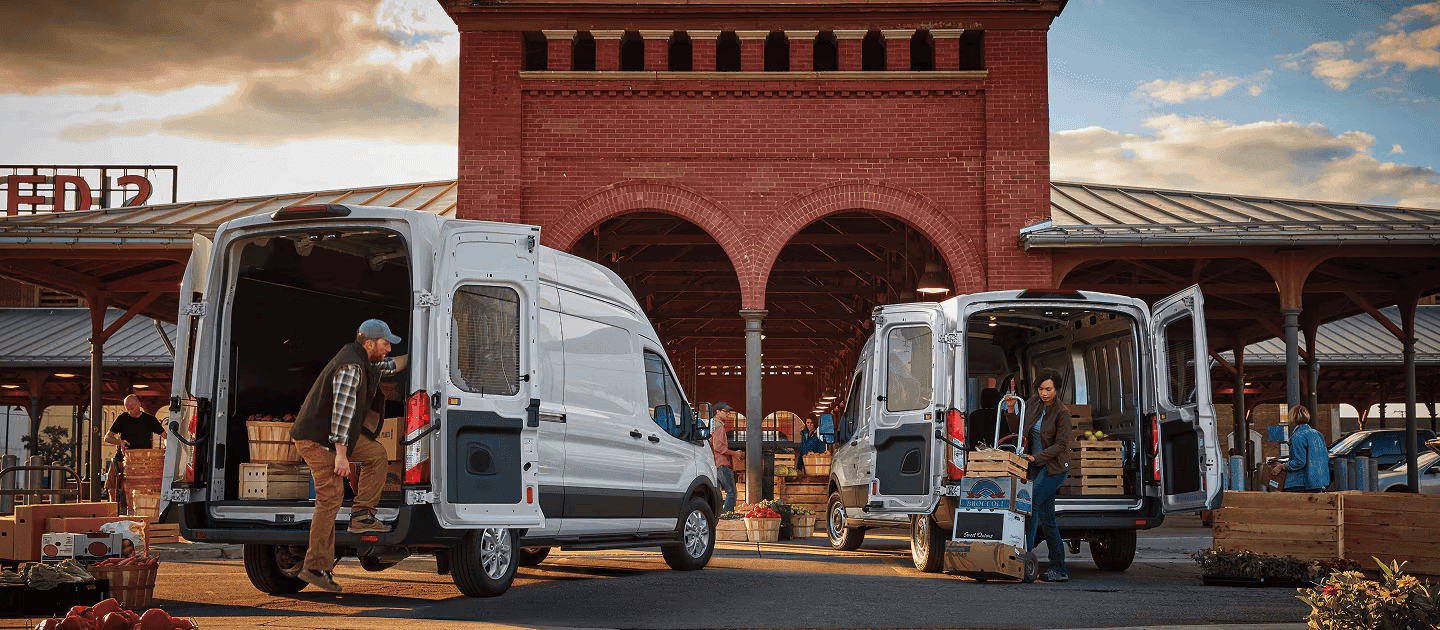
The 2026 Ford Transit Cargo Van — built at Ford’s Kansas City Assembly Plant and available in Low, Medium, and High Roof configurations. Rob Sight Ford serves Kansas City, Overland Park, Lee’s Summit, and the broader Missouri metro.
Body Length, Wheelbase, and Payload Capacity by Model
Once you’ve chosen a roof height, body length and model tier determine how much your Transit can actually carry. The wheelbase choice sets cargo volume and turning radius. The model choice — T-150, T-250, T-350, or T-350 HD — sets the payload ceiling. Together, these decisions determine whether your van is truly built for your workload or just close enough.
Regular vs. Long vs. Extended Wheelbase
The Regular wheelbase (129.9 inches, ~235-inch body length) is purpose-built for dense urban environments. It fits in tight parking structures around the Kansas City metro, handles narrow loading docks, and navigates downtown streets without the overhangs that frustrate long-van drivers. The Long wheelbase (147.6 inches, ~264-inch body length) gives you significantly more cargo hold and better weight distribution when you’re consistently loading near maximum payload. The Extended-Length configuration takes cargo space further still — the choice for high-volume delivery fleets and operations moving bulky equipment.
| Configuration | Wheelbase | Approx. Body Length | Best Use Case |
|---|---|---|---|
| Regular | 129.9 inches | ~235 inches | Urban delivery routes, tight city streets, confined loading areas |
| Long | 147.6 inches | ~264 inches | High-volume cargo, service trades, heavier payload distribution |
| Extended-Length | 148+ with body extension | Maximum | High-volume delivery fleets, large equipment, maximum cargo builds |
Door access is worth factoring into the body length decision. Every Transit comes standard with wide 50/50 split rear doors that open 180 degrees. An available 253-degree rear door opening allows flush-to-body access for easier loading from tight docks. A passenger-side sliding door is standard, with dual sliding doors available for curbside and streetside loading on high-frequency delivery runs.
Payload Capacity Across T-150, T-250, T-350, and T-350 HD
The Transit model tier — T-150 through T-350 HD — is what determines how much your van can carry. Each model is built on a progressively heavier chassis with stronger axles and suspension rated for increasing commercial demands. The T-350 HD can exceed 5,100 pounds of payload in certain configurations, putting it in a different category from the T-150’s general-use 3,680-pound rating.
| Model | Max Payload | Starting MSRP | Best For |
|---|---|---|---|
| Transit 150 | Up to 3,680 lbs | $50,495 | Light delivery, service trades, tool transport, fleet entry point |
| Transit 250 | Up to 4,080 lbs | $51,800 | General commercial use, plumbers, electricians, general contractors |
| Transit 350 | Up to 4,480 lbs | $53,000 | Heavy commercial hauling, fully loaded trade packages, HVAC equipment |
| Transit 350 HD | Up to 5,114 lbs | $54,000 | Maximum-duty commercial applications, heavy equipment, high-frequency hauling |
For Kansas City contractors managing compliance with commercial vehicle weight regulations, understanding the difference between GVWR and payload rating matters. If your loads frequently push above 3,500 pounds, the T-250 or T-350 is a better long-term choice than stretching the T-150 beyond its intended range. Business buyers should also review how Section 179 tax deductions apply to commercial vehicle purchases — the Transit qualifies, and the deduction can meaningfully offset the cost difference between model tiers.
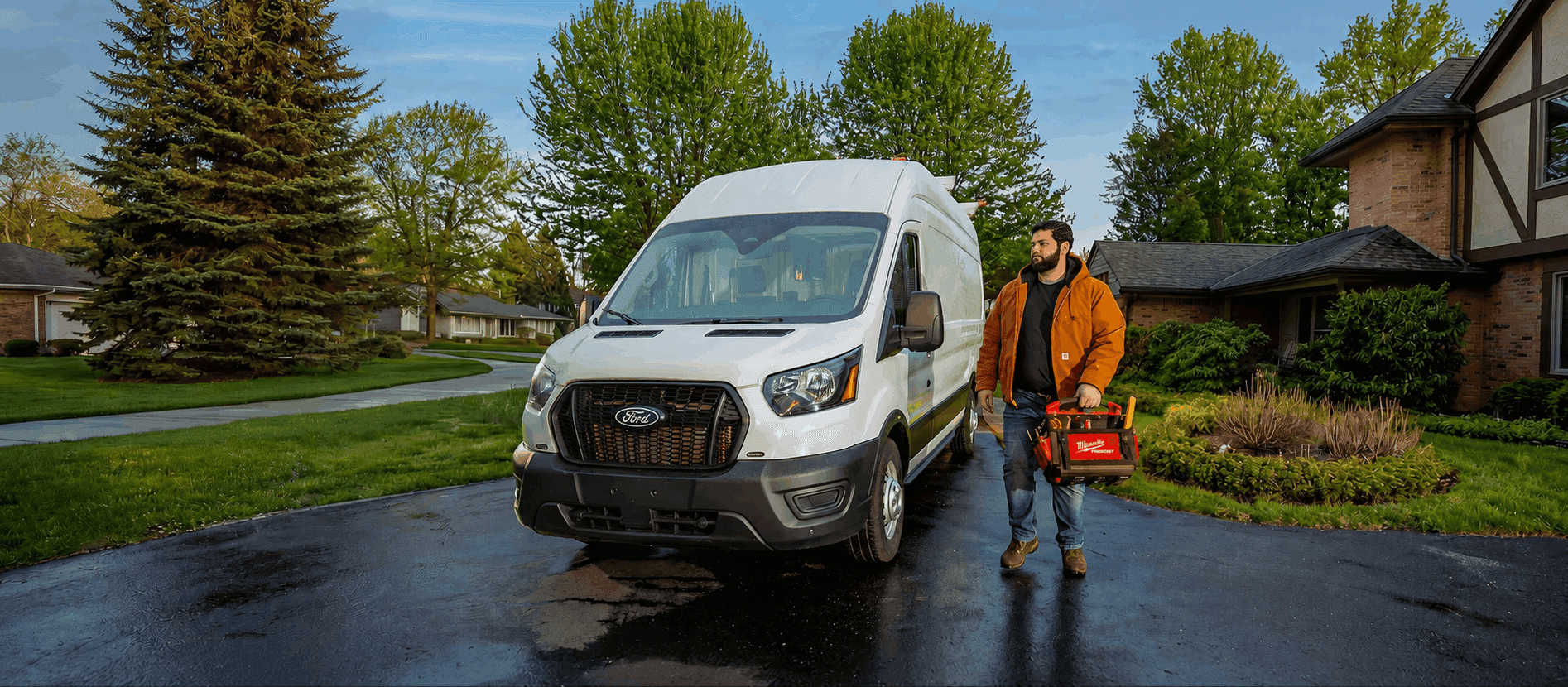
The 2026 Ford Transit’s high-strength unitized steel body is available in Regular, Long, and Extended-Length configurations across T-150 through T-350 HD models. Available at Rob Sight Ford in Kansas City, MO.
Powertrain Options, Towing Capacity, and Drivetrain Choices
Engine choice on the Transit is straightforward: two gasoline options, a 10-speed automatic standard across both, and an intelligent all-wheel drive system available as an add-on. The right choice depends on your typical load weight, route elevation changes, and whether you regularly tow equipment or trailers.
3.5L PFDI V6 vs. 3.5L EcoBoost V6
The standard 3.5L PFDI V6 uses Port Fuel and Direct Injection to produce 275 horsepower and 262 lb-ft of torque — enough for daily delivery routes, moderate cargo loads, and the majority of light-to-medium commercial applications. For operations where the van is regularly loaded near its rated capacity, towing equipment, or running routes with significant elevation changes, the 3.5L EcoBoost V6 is the right upgrade. The twin-turbocharged EcoBoost produces 310 horsepower and 400 lb-ft of torque — 138 lb-ft more than the base engine, most noticeable at low RPM when launching from a stop with a full load or climbing grades on Missouri routes. The EcoBoost adds $2,100–$2,500 to the purchase price and is standard on higher GVWR models.
| Specification | 3.5L PFDI V6 | 3.5L EcoBoost V6 |
|---|---|---|
| Horsepower | 275 HP | 310 HP |
| Torque | 262 lb-ft | 400 lb-ft |
| Aspiration | Naturally Aspirated | Twin-Turbocharged |
| Price Premium | Base | +$2,100–$2,500 |
| Best For | Daily routes, moderate loads, cost-focused fleets | Heavy loads, towing, grades, demanding commercial use |
10-Speed SelectShift and Intelligent AWD
Both engines pair with a 10-speed SelectShift automatic transmission that keeps the engine in its optimal power band across a wide range of load conditions. Tow/Haul Mode adjusts shift points and helps manage braking on descents when pulling a trailer. For operations in wet or icy Kansas City winters, the Intelligent All-Wheel Drive system is available for $4,000–$4,700. Unlike traditional 4WD systems that raise the floor and increase step-in height, the Transit’s intelligent AWD maintains the standard floor height — keeping loading comfortable. The system distributes torque proactively between axles before wheel slip occurs.
Towing Capacity: Standard and with the Heavy-Duty Package
| Feature | Standard Setup | With Heavy-Duty Trailer Tow Package |
|---|---|---|
| Max Towing Capacity | 5,100 lbs | 6,900 lbs |
| Tow/Haul Mode | Included | Included |
| Trailer Sway Control | Included | Included |
| Enhanced Wiring Harness | Not Included | Included |
| Upgraded Radiator | Not Included | Included |
For operations that require towing above 5,000 pounds — landscapers pulling equipment trailers, contractors moving materials across Kansas City job sites, or mobile businesses towing support trailers — the Heavy-Duty Trailer Tow Package is a straightforward add-on. The upgraded radiator is particularly relevant for operations in summer heat when towing at or near capacity. Buyers who need significantly more towing capability should also consider the 2026 Ford F-250, which serves applications requiring 15,000+ pounds of towing capacity.
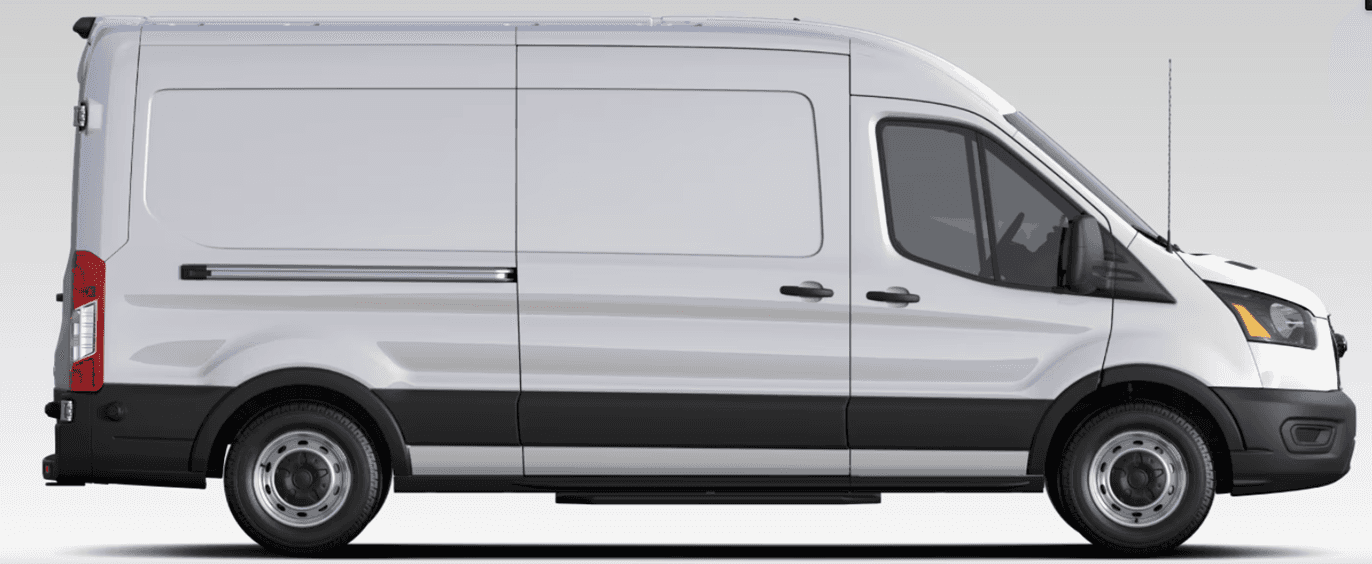
The 2026 Ford Transit with SYNC 4, Ford Pro Telematics, and available factory trade packages — ready for upfit from day one. Rob Sight Ford in Kansas City stocks the full Transit Cargo Van lineup.
Ford Pro Technology, Factory Upfit Packages, and Safety
Ford Pro Fleet Management Technology
The 2026 Transit comes standard with FordPass Connect and a 5G LTE Wi-Fi hotspot that connects up to 10 devices simultaneously. Ford Pro Telematics is included with a 90-day trial and tracks fuel consumption, idle time, service alerts, and driver behavior. Fleet managers can set speed limits and manage vehicles remotely — the kind of visibility that pays for itself quickly on a multi-van operation.
SYNC 4 with 12-Inch Touchscreen
Faster processor, improved voice recognition, and wireless Apple CarPlay and Android Auto. Drivers navigate, make calls, and manage media without taking hands off the wheel — which matters on a 10-hour delivery shift.
Vehicle Integration System 2.0
Controls upfitter equipment — snow plows, salt spreaders, warning lights, specialty tools — directly from the SYNC touchscreen. No extra wiring, no holes drilled in the dash. A significant installation cost reduction over older wiring approaches.
Digital Rearview Mirror
A standard rearview mirror is useless when the cargo area is floor-to-ceiling full. The digital rearview mirror shows a live rear camera feed instead, giving drivers full rear visibility regardless of how the van is loaded.
Ford Pro Telematics
Tracks fuel use, idle time, service needs, and driver behavior across your entire fleet from a single portal. Speed limit controls and remote vehicle management available. The difference between reactive maintenance and proactive fleet health management.
Factory Trade Packages: Job-Ready from Day One
Through the Ford Pro Upfitter program, the 2026 Transit is available with four factory-installed trade packages that make the van immediately functional for specific industries — without the lead time and cost of aftermarket upfit. Every package includes a safety partition between the cab and cargo area.
Electrician Package
Tiered shelving, specialty drawers, organized storage bins, and wire spool holders designed for electrical contractors. Purpose-built for tool organization and wire management — built in from the factory, not added later.
HVAC Package
Heavy-duty shelving, parts bins, and secure racks built to hold refrigerant tanks safely and compliantly. HVAC technicians across the Kansas City metro can order a van that’s compliant from the first day on the job.
General Contractor Package
Steel shelving, deep drawers, bins, hooks, and holders sized for blueprints and power tools. Built for contractors who need organized access to a wide variety of tools and materials across multiple job sites daily.
Delivery Package
Deep folding shelves designed for high-volume package loads, purpose-built for last-mile delivery operations. Shelf configurations maximize the van’s cargo volume while maintaining organized access during the route.
For buyers needing customization beyond the four factory packages, Ford partners with Utilimaster (shelving and refrigeration), Knapheide (heavy-duty partitions and storage), Ranger Design (lightweight aluminum shelving), and Legend Fleet Solutions (floor, wall, and ceiling protection kits).
Ford Co-Pilot360 Safety Technology
The 2026 Transit includes Ford Co-Pilot360 as a comprehensive standard safety suite. Pre-Collision Assist with Automatic Emergency Braking detects vehicles and pedestrians and applies brakes automatically when a collision is likely. Lane-Keeping Alert vibrates the steering wheel when the van drifts; Lane-Keeping Aid actively steers it back on course. BLIS with Cross-Traffic Alert — available with trailer coverage — monitors blind spots including the full trailer length. A 360-Degree Camera with Split View simplifies maneuvering in tight Kansas City loading docks and narrow job site entrances. Post-Collision Braking and an SOS Post-Crash Alert System round out the suite. Available upgrades include Adaptive Cruise Control with Stop-and-Go, Lane Centering, and Intersection Assist.
Find Your Ford Transit Configuration at Rob Sight Ford in Kansas City
Rob Sight Ford stocks the 2026 Ford Transit Cargo Van across multiple configurations — roof heights, body lengths, model tiers, and powertrain options — so you can compare them in person and make a configuration decision based on real vehicles, not spec sheets. Our commercial vehicle team works with contractors, delivery fleets, HVAC companies, and independent operators across Kansas City, Overland Park, Lee’s Summit, and the broader Missouri metro every day.
Call us at 816-895-6901 to discuss your specific cargo and payload requirements, browse current Transit inventory online, or apply for commercial fleet financing before you arrive. Every Transit comes with a 3-year/36,000-mile bumper-to-bumper warranty and 5-year/60,000-mile powertrain coverage, plus 24/7 roadside assistance.
Frequently Asked Questions
What are the available roof height options for the 2026 Ford Transit Cargo Van?
The 2026 Ford Transit Cargo Van comes in three roof heights. The Low Roof is 82.2 inches tall with 56.9 inches of interior standing height and 246.7 cubic feet of cargo volume — ideal for delivery operations where drivers load from outside. The Medium Roof reaches 101 inches overall with 72 inches (6’0″) of interior height and 337–398 cubic feet, suitable for service technicians who need to stand and work inside. The High Roof is 110 inches tall with 81.5 inches (6’9″) of interior height and up to 487.3 cubic feet — the right choice for mobile workshops and high-volume delivery builds.
What is the maximum cargo volume and payload capacity of the 2026 Ford Transit Cargo Van?
The maximum cargo volume is 487.3 cubic feet in the High Roof Extended-Length configuration. The Low Roof Regular-Length provides 246.7 cubic feet. For payload, the Transit 150 carries up to 3,680 pounds, the Transit 250 up to 4,080 pounds, and the Transit 350 and 350 HD up to 4,480 pounds — with some T-350 HD configurations reaching 5,114 pounds. Maximum towing capacity is 6,900 pounds with the Heavy-Duty Trailer Tow Package.
What engine options are available on the 2026 Ford Transit Cargo Van?
The standard engine is a 3.5L PFDI V6 with 275 horsepower and 262 lb-ft of torque — efficient for daily routes and moderate loads. The available 3.5L EcoBoost V6 is twin-turbocharged, producing 310 horsepower and 400 lb-ft of torque, adding $2,100–$2,500 over the base price and standard on higher GVWR models. Both pair with a 10-speed SelectShift automatic. Intelligent AWD is available for $4,000–$4,700. An all-electric E-Transit is also available starting at $55,355.
What is the difference between the Regular and Long wheelbase on the 2026 Ford Transit?
The Regular wheelbase measures 129.9 inches (~235-inch body length) — ideal for urban delivery routes, tight city streets, and confined loading docks. The Long wheelbase stretches to 147.6 inches (~264-inch body length), providing greater cargo volume and better weight distribution for heavier loads. An Extended-Length version is available for maximum cargo capacity. Overall width is 81 inches without mirrors, 97 inches with mirrors.
What factory upfit packages are available for the 2026 Ford Transit at Rob Sight Ford?
Through the Ford Pro Upfitter program, the 2026 Transit offers four factory-installed trade packages: the Electrician Package (tiered shelving, specialty drawers, wire spool holders), the HVAC Package (heavy-duty shelving, refrigerant tank racks), the General Contractor Package (steel shelving, blueprint holders), and the Delivery Package (deep folding shelves for package loads). Every package includes a safety partition. National upfit partners include Utilimaster, Knapheide, Ranger Design, and Legend Fleet Solutions. Rob Sight Ford serves Kansas City, Overland Park, Lee’s Summit, and the broader Missouri metro.
0 comment(s) so far on 2026 Ford Transit Cargo Van Configurations: Roof Heights, Body Lengths & Payload