

2026 Ford Super Duty Towing Capacity: F-250, F-350, F-450, and F-550
A complete 2026 Ford Super Duty towing capacity chart comparing the F-250, F-350, F-450, and F-550, so Kansas City haulers, ranchers, and contractors can match the right truck to the trailer
Ask ten truck shoppers what “Super Duty towing capacity” means and you’ll get ten different answers, because the number changes with the hitch type, the axle ratio, the cab, and whether the rear wheels are single or dual. Ford builds the F-250, F-350, F-450, and F-550 on a shared platform, but each step up the ladder trades a little ride comfort and price for real gains in GVWR, frame strength, and how much trailer you can safely put behind it.
That range is exactly what makes shopping Super Duty confusing: buy too little truck and you’re overloaded on your heaviest hauling day; buy too much and you’re paying for capability — and a stiffer dually ride — you’ll never use. At Rob Sight Ford, our commercial and retail teams help Kansas City buyers pull the right chart numbers for their actual trailer before they sign, not after. This guide lays out the full 2026 Ford Super Duty towing capacity chart across all four series, and if you’re narrowing in on a single model, our dedicated 2026 Ford F-350 towing capacity guide breaks that truck down by trim and configuration.
Key Takeaways
- The 2026 Super Duty lineup spans four series — F-250, F-350, F-450, and F-550 — sharing a cab and up to four available engines.
- Max gooseneck/fifth-wheel towing tops out at 40,000 lbs on a properly equipped F-450, with the F-350 rated up to 38,000 lbs.
- Max conventional (bumper-hitch) towing ranges from 22,000 lbs on the F-250 to 30,000 lbs on the F-450.
- The standard 6.8L V8 makes 405 hp and 445 lb-ft; the top 6.7L High-Output Power Stroke diesel makes 500 hp and 1,200 lb-ft and is required for maximum tow ratings.
- Payload peaks around 8,000 lbs on select F-350 builds; the F-450 and F-550 trade payload and towing headline numbers for higher GVWR and frame capacity instead.
- Pricing starts around $45,975 for an F-250 XL and climbs past $62,000 for an F-450 XL, with F-550 chassis cab pricing varying widely by the commercial body installed.
Super Duty Lineup — At a Glance
F-250 Starting: ~$45,975 | F-450 Starting: ~$62,330 | Series: 4 | Max Torque: 1,200 lb-ft
Understanding the 2026 Ford Super Duty Lineup
Ford doesn’t badge the Super Duty by trim alone the way it does the F-150. The F-250, F-350, F-450, and F-550 are separate series, each built to a different gross vehicle weight rating (GVWR) on top of the same cab, the same engine menu, and largely the same technology. GVWR is the ceiling: it’s the truck’s own weight plus everything it carries, and it’s the number that ultimately decides how much axle and frame capacity is left over for towing.
As a rule of thumb, a heavier GVWR series can be built with a stronger frame, bigger brakes, and — on the F-350 and up — dual rear wheels, all of which raise the towing ceiling. Here’s how the four series stack up before engine, cab, or axle ratio are factored in:
| Series | Starting MSRP* | Max GVWR | Best For |
|---|---|---|---|
| F-250 | ~$45,975 | Up to 11,400 lbs | Daily-driver trucks that tow occasionally |
| F-350 | ~$47,270 | Up to 14,000 lbs | Regular towing: RVs, horse trailers, equipment |
| F-450 | ~$62,330 | Up to 19,500 lbs | Maximum gooseneck towing, heavy loads |
| F-550 | ~$60,000+ (chassis) | Up to 37,000 lbs | Commercial upfits: dump, flatbed, wrecker |
*Starting MSRP figures are approximate and exclude destination and options; F-550 is sold as a chassis cab, so total price depends heavily on the upfitted body. Always confirm current pricing with our commercial team.
Why GVWR Is the Real Story Behind Every Towing Number
Towing capacity, payload, and GVWR are all connected: a truck’s GVWR minus its actual curb weight is what’s left for passengers, cargo, and tongue or hitch weight from a trailer. That’s also why two trucks in the same series can carry different towing ratings — a lighter-optioned crew cab with a smaller fuel tank has more of its GVWR “budget” left over than a loaded-up truck with a bigger cab and more standard equipment.
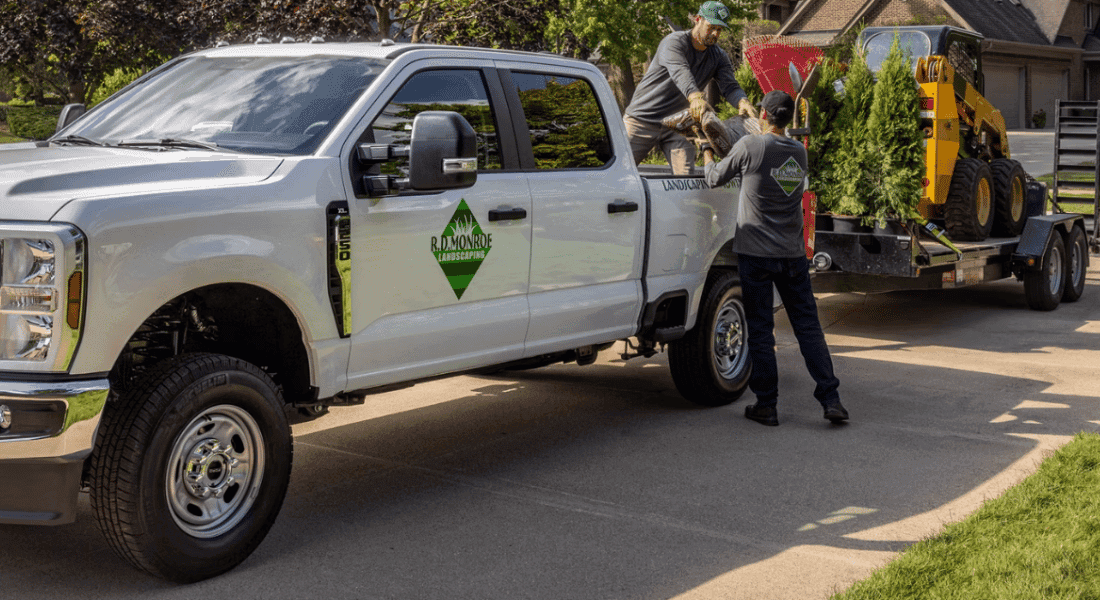
The 2026 Super Duty lineup runs from the everyday F-250 through the commercial-grade F-550 chassis cab. Rob Sight Ford stocks multiple series and configurations for Kansas City buyers to compare side by side.
Engines and Powertrains: What Pairs With What
Every 2026 Super Duty starts with the standard 6.8L V8 gas engine, with the 7.3L V8 gas, 6.7L Power Stroke diesel, and 6.7L High-Output Power Stroke diesel available up the lineup — the HO diesel is required equipment to unlock the F-350’s, F-450’s, and F-550’s maximum towing figures. All four engines pair with a 10-speed TorqShift automatic transmission. For a deeper dive on the diesel that does the heaviest lifting, see our 6.7L Power Stroke specs breakdown.
6.8L V8 Gas (Standard)
405 horsepower and 445 lb-ft of torque on regular fuel. Standard across F-250 and F-350 — the lower-cost choice for trucks that tow occasionally and prioritize purchase price and simplicity over outright capacity.
7.3L V8 Gas (“Godzilla”)
430 horsepower and 485 lb-ft of torque from Ford’s largest gas V8. Available across most of the lineup — a strong middle ground for buyers who want gas-engine simplicity with more muscle than the standard V8.
6.7L Power Stroke Diesel
475 horsepower and 1,050 lb-ft of torque. Available across the lineup for buyers who tow often and want diesel efficiency and torque without stepping up to the High-Output version.
6.7L HO Power Stroke Diesel
500 horsepower and 1,200 lb-ft of torque — the engine behind every Super Duty’s maximum towing figure. Standard on F-450 and F-550, available on F-350; required for the 38,000-lb and 40,000-lb gooseneck ratings.
| Powertrain | Horsepower | Torque | Typical Availability |
|---|---|---|---|
| 6.8L V8 Gas | 405 hp | 445 lb-ft | Standard: F-250, F-350 |
| 7.3L V8 Gas | 430 hp | 485 lb-ft | Available: F-250 through F-550 |
| 6.7L Power Stroke | 475 hp | 1,050 lb-ft | Available: F-250 through F-550 |
| 6.7L HO Power Stroke | 500 hp | 1,200 lb-ft | Standard: F-450, F-550; Available: F-350 |
Because the HO Power Stroke is available so widely, engine choice is really a towing-and-payload decision more than a comfort upgrade — most buyers should decide on series and configuration first, then choose the engine that unlocks the tow rating their trailer actually requires.
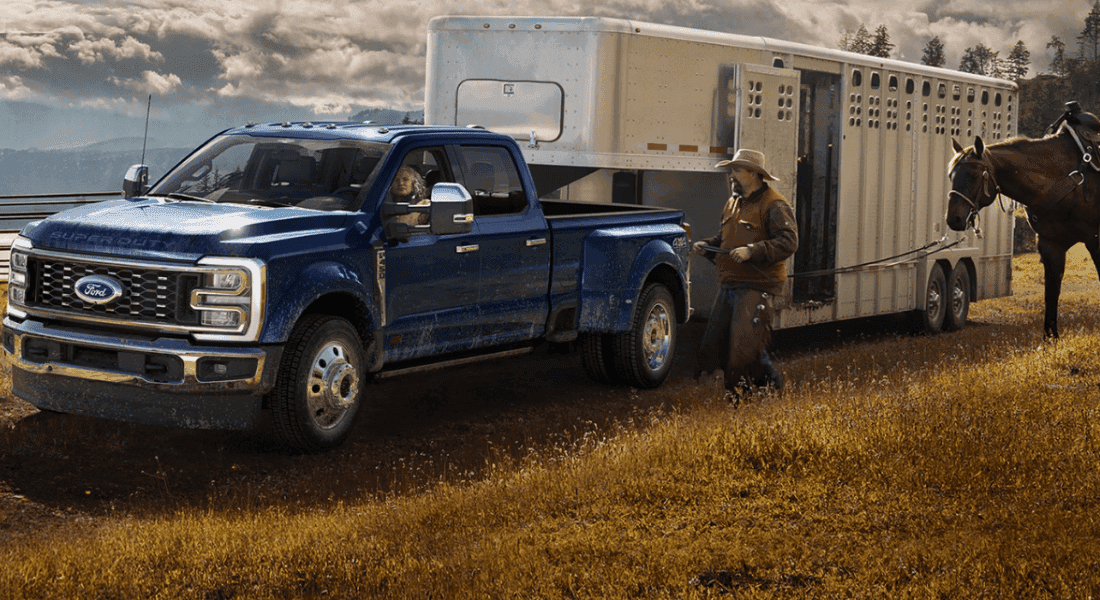
Engine and configuration choice largely determine a Super Duty’s real-world towing number, independent of series badge alone. Rob Sight Ford’s commercial team can help you spec the right combination.
2026 Ford Super Duty Towing Capacity Chart: F-250 vs. F-350 vs. F-450 vs. F-550
Here’s the core comparison most Super Duty shoppers are looking for — maximum GVWR, payload, conventional towing, and fifth-wheel/gooseneck towing side by side for all four series. Figures below reflect each model’s highest-rated configuration with the required engine, axle ratio, and towing package; your specific build may rate lower.
| Model | Max GVWR | Max Payload | Max Conventional Tow | Max 5th-Wheel/Gooseneck Tow |
|---|---|---|---|---|
| F-250 (SRW) | Up to 11,400 lbs | Up to 4,260 lbs | 22,000 lbs | 23,000 lbs |
| F-350 (SRW/DRW) | Up to 14,000 lbs | Up to 8,000 lbs | 28,000 lbs | 38,000 lbs |
| F-450 (DRW) | Up to 19,500 lbs | Up to 6,500 lbs | 30,000 lbs | 40,000 lbs |
| F-550 (Chassis Cab, DRW) | Up to 37,000 lbs | Varies by upfit body | ~20,000 lbs | ~34,300 lbs |
Figures are manufacturer maximums for properly equipped trucks and vary by cab, wheelbase, axle ratio, and towing package. F-550 is sold as a chassis cab, so payload and effective towing depend heavily on the installed commercial body — ask our commercial team to confirm ratings for your specific build.
Conventional vs. Fifth-Wheel and Gooseneck Towing: Why the Numbers Jump
Notice how every model’s fifth-wheel/gooseneck number is dramatically higher than its conventional number. A rear-hitch trailer’s tongue weight hangs entirely behind the truck’s rear axle, which limits how much weight the frame and suspension can safely handle. A fifth-wheel or gooseneck hitch sits directly over or just ahead of the rear axle instead, distributing weight through the frame far more efficiently — which is why the same F-450 that tows 30,000 lbs on a conventional hitch can pull 40,000 lbs with a gooseneck trailer. If you’re weighing whether the jump from an F-250 to F-350 is worth it for your trailer, the guide linked above breaks the SRW-vs-DRW decision down further.
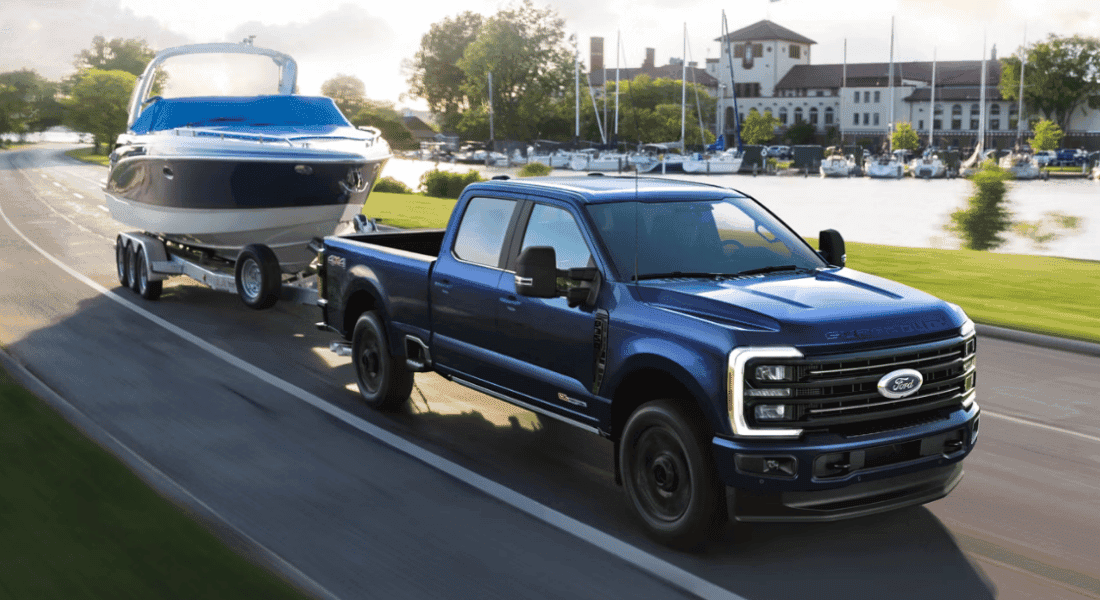
From daily-driver F-250s to commercial F-550 chassis cabs, the 2026 Super Duty lineup lets Kansas City buyers size the truck to the trailer or the upfit. Rob Sight Ford stocks multiple configurations for side-by-side comparison.
Factors Beyond the Chart That Change Your Real Tow Rating
The Details That Move the Number Up or Down
The figures in the chart above are each model’s ceiling, achieved with a specific combination of cab, engine, axle ratio, and towing package. Change any one of those and the number moves — sometimes by thousands of pounds. Here’s what actually shifts a Super Duty’s rating on the window sticker:
Axle Ratio
A numerically higher rear axle ratio (like 4.30 vs. 3.31) trades a little highway fuel economy for more low-end pulling power and a higher tow rating — often the difference between a truck’s advertised max figure and a more common everyday build.
Cab, Bed & Wheelbase
Regular Cab trucks are lighter and often rate higher than Crew Cab versions of the same series, since less of the GVWR budget goes to the cab itself. Wheelbase also affects gooseneck and fifth-wheel geometry and clearance.
Single vs. Dual Rear Wheels
Dual rear wheels (DRW) spread weight across four rear tires instead of two, boosting payload and towing stability — available on F-350 and standard on F-450/F-550 — at the cost of a wider stance and a firmer ride when unloaded.
GVWR & Towing Packages
Optional packages — including axle upgrades and dedicated high-capacity gooseneck towing packages — raise a specific build’s GVWR and tow rating above the series’ standard figure, which is how F-450s reach their 40,000-lb ceiling.
Deciding between staying on an F-250 or stepping up to an F-350 for your business often comes down to these same details rather than the series badge alone — our F-250 vs. F-350 business comparison walks through that decision in more depth.
| Factor | Impact on the Decision | Guidance |
|---|---|---|
| Axle ratio | Higher ratio raises tow rating, lowers highway MPG | Confirm the axle ratio on any advertised max figure |
| Cab & bed length | Lighter cabs leave more GVWR budget for towing | Weigh crew-cab convenience against tow rating |
| SRW vs. DRW | DRW adds payload and stability, not always outright max tow | Choose DRW for heavy, frequent hauling |
| GVWR/towing packages | Unlocks each model’s advertised ceiling figure | Confirm the package is on the specific truck you’re buying |
Trailer Technology That Makes the Numbers Usable
A high tow rating only helps if the driver can actually manage the trailer behind it. Ford builds several tools into the Super Duty specifically to make towing near the top of the chart safer and less stressful, whether it’s a first-time RV owner or a crew hitching up a gooseneck every morning:
Pro Trailer Backup Assist
Lets the driver steer the trailer into a spot using a dash-mounted knob instead of the steering wheel, turning one of the hardest parts of towing into a mostly hands-off maneuver.
Smart Hitch & Onboard Scales
Onboard scales estimate payload and tongue weight in real time, while Smart Hitch (via the FordPass app) helps confirm a trailer is within the truck’s rated limits before you pull away.
Integrated Trailer Brake Controller
A factory brake controller is built into the dash on most Super Duty configurations, syncing trailer braking with the truck’s own brakes instead of requiring an aftermarket add-on.
360-Degree Camera & Trailer Views
Available camera angles show the hitch, the trailer’s sides, and a reverse view that helps line up a gooseneck or fifth-wheel coupler without a spotter.
These features are available across most of the lineup rather than locked to the top trims, so a work-focused XL doesn’t have to give up the tools that make maximum-capacity towing manageable. For fleets running Super Duty alongside Transit vans, our Ford Pro commercial vehicle fleet buying guide covers how these tools tie into fleet management across the whole lineup.
The Price Ladder — and What Each Step Buys You
Sticker price climbs steadily up the Super Duty lineup, but so does what you’re actually buying — more GVWR, a stronger frame, and eventually dual rear wheels. Rob Sight Ford also offers standing pricing of $100 below invoice on new Ford trucks (excluding specialty builds), so treat the figures below as a starting point for negotiation, not your final number.
| Model | Starting MSRP* | Max GCWR | What You Gain |
|---|---|---|---|
| F-250 | ~$45,975 | Up to 31,000 lbs | Baseline Super Duty capability |
| F-350 | ~$47,270 | Up to 45,600 lbs | Higher GVWR, DRW available, HO diesel available |
| F-450 | ~$62,330 | Up to 48,000 lbs | Standard HO diesel, max gooseneck rating |
| F-550 (Chassis Cab) | ~$60,000+ | Varies by upfit | Highest GVWR, built for vocational bodies |
*Approximate figures before destination charge and options; F-550 pricing depends heavily on the commercial body installed. Confirm exact pricing and GCWR for your build with our commercial team.
Running costs move with engine choice as much as series: diesel trucks cost more upfront and add periodic DEF fluid top-offs, but typically hold their value better and tow more efficiently over a long haul than a comparably rated gas truck working near its limit. Business buyers should also note that most Super Duty trucks exceed the 6,000-lb GVWR threshold for full first-year Section 179 expensing — worth discussing with your tax advisor. Our Super Duty Section 179 guide walks through the current deduction limits by model.
Making the Final Call: Which Super Duty Fits What You Tow?
The cleanest way to decide is to weigh your actual trailer — loaded, not empty — against the chart above, then leave yourself a margin rather than shopping right up to a truck’s rated max. Here’s how common Kansas City towing scenarios map to the lineup:
| Towing Scenario | Recommended Build | Why |
|---|---|---|
| Weekend camper or light equipment trailer | F-250, SRW | Plenty of capacity without dually cost or ride |
| Horse trailer, fifth-wheel RV, regular hauling | F-350, SRW or DRW | Higher GVWR and gooseneck rating for frequent use |
| Max gooseneck towing, heavy livestock or equipment | F-450, DRW | Ford’s highest available towing ceiling |
| Commercial upfit — dump, flatbed, wrecker | F-550 Chassis Cab | Highest GVWR for a body-mounted payload, not a trailer |
One nuance worth flagging before you spec a truck: towing near the top of this chart with an F-450 or F-550 can push combined weight into territory where commercial drivers may need a CDL, depending on your state and how the truck is used. Confirm requirements with the Missouri or Kansas DMV if you’re buying for business use. And if you’re still deciding between the F-250 and F-350 specifically, our F-250 trim levels guide breaks down pricing and features by trim to help narrow the choice.
Still not sure which chart line matches your trailer? The fastest way to know for certain is to bring your trailer’s actual weight — or the number off its title — to our commercial team, and we’ll match it to a truck and configuration that covers it with room to spare.
Tips for Reading a Super Duty Towing Chart Correctly
A chart tells you what’s possible in a specific configuration — these tips help make sure the truck you actually order matches the number you’re counting on:
Weigh the Loaded Trailer, Not the Empty One
A trailer’s own weight plus everything on it — livestock, equipment, water in a camper’s tanks — is what counts against a truck’s tow rating, not the empty trailer weight on the title.
Check the Door-Jamb Sticker, Not Just the Brochure
Every Super Duty carries its own GVWR and payload rating on the driver’s door jamb, reflecting its specific engine, cab, and options — that number, not the lineup-wide maximum, is what applies to the truck you own.
Leave a Margin Below the Max
Shopping for a truck rated right at your trailer’s weight leaves no room for cargo, passengers, or a heavier trailer down the road — most experienced haulers aim to stay comfortably under the rated max.
Match the Hitch Type to Your Trailer
If a trailer can be ordered with a gooseneck or fifth-wheel coupler instead of a bumper-pull setup, that swap alone can add thousands of pounds of usable towing capacity on the same truck.
Compare Every Super Duty Configuration at Rob Sight Ford in Kansas City
Whether you’re replacing a family truck that’s outgrown your camper, adding an F-450 for max gooseneck towing, or spec’ing an F-550 chassis for a commercial upfit, Rob Sight Ford in Kansas City has the Super Duty inventory and commercial expertise to help you choose with confidence. We serve businesses and families throughout the Kansas City metro — including Overland Park, Lee’s Summit, Grandview, and Blue Springs — and our team is fluent in every Super Duty series, engine, and towing configuration available.
Call us at 816-895-6901, apply for financing before you arrive, or reach out to schedule a side-by-side comparison of the truck and trailer combination you have in mind.
Frequently Asked Questions
What is the maximum towing capacity of the 2026 Ford Super Duty lineup?
The 2026 Ford Super Duty tops out at 40,000 lbs of gooseneck towing on a properly equipped F-450 with the 6.7L High-Output Power Stroke diesel. The F-350 is close behind at up to 38,000 lbs gooseneck and 28,000 lbs on a conventional hitch, while the lighter F-250 is rated for up to 23,000 lbs gooseneck and 22,000 lbs conventional. The commercial-grade F-550 chassis cab trades headline tow numbers for higher GVWR and payload depending on the body it’s upfitted with.
What is the difference in towing capacity between the F-250, F-350, F-450, and F-550?
Moving up the Super Duty lineup mainly buys GVWR, axle strength, and frame capacity rather than a completely different truck. The F-250 tops out around 22,000-23,000 lbs, the F-350 climbs to 28,000-38,000 lbs depending on hitch type and single- vs. dual-rear-wheel configuration, the F-450 reaches Ford’s advertised 40,000-lb gooseneck maximum, and the F-550 is built as a chassis cab for vocational upfits where GVWR and payload matter more than a headline tow rating.
Do you need a CDL to tow with a Ford F-450 or F-550?
Usually not for personal, non-commercial towing, but it depends on combined weight and your state’s rules. Federal guidelines generally call for a commercial driver’s license once GCWR exceeds 26,001 lbs and the towed trailer’s GVWR is over 10,000 lbs, a threshold a loaded F-450 or F-550 pulling a large gooseneck or livestock trailer can reach. Missouri and Kansas both offer non-commercial exemptions for personal towing, but business owners hauling for commercial purposes should confirm requirements with the DMV before spec’ing a truck.
What is the difference between conventional, fifth-wheel, and gooseneck towing capacity?
Conventional towing uses a rear bumper or receiver hitch and carries the lowest capacity because the trailer’s tongue weight rides entirely behind the rear axle. Fifth-wheel and gooseneck setups mount the hitch point over or just ahead of the rear axle, spreading weight more evenly across the truck’s frame, which is why every Super Duty model tows thousands of pounds more with a gooseneck or fifth-wheel trailer than with a conventional hitch.
Which Ford Super Duty is best for towing in Kansas City?
Most Kansas City buyers who tow horse trailers, campers, or equipment trailers a few times a month do well with an F-250 or F-350 single-rear-wheel truck, which offers plenty of capacity without the cost and stiffer ride of a dually. Businesses or ranchers who tow near-max weights regularly, or who need dual rear wheels for stability, should step up to an F-350 DRW or F-450. F-550 chassis cab buyers are typically outfitting a dump bed, flatbed, or wrecker body rather than towing a separate trailer at all.
0 comment(s) so far on 2026 Ford Super Duty Towing Capacity: F-250, F-350, F-450, and F-550