

2026 Ford F-250 vs. F-350: Which Super Duty Is Right for Your Business?
A side-by-side towing, payload, and cost comparison to help Kansas City business owners choose the right 2026 Ford Super Duty — F-250 or F-350 — for the work they actually do
They look nearly identical in the parking lot, share the same cabs and the same engines, and sit side by side on the lot — so does it really matter whether your business buys an F-250 or an F-350? The answer is yes, and the gap is bigger than most buyers expect. Choose wrong and you either overpay for capability you’ll never use, or you max out a truck that was never built for the loads you’re putting on it. Either mistake costs money every month.
The 2026 Ford F-250 Super Duty and F-350 differ most in payload, towing, and rear-axle configuration — and those differences map directly to the kind of work you do. Whether you’re pulling a landscape trailer around the metro or hauling a loaded gooseneck across state lines, the right choice comes down to weight, not badges. At Rob Sight Ford, our commercial team walks business owners through this decision every week. Start by browsing the current 2026 Ford Super Duty lineup, then use this guide to match the truck to the job.
Key Takeaways
- The F-250 and F-350 share the same cabs, beds, and four V8 engines — the real difference is capacity and rear-axle setup.
- The F-250 tows up to ~23,000 lbs and carries up to ~4,246 lbs of payload; the F-350 tows up to ~38,000 lbs and carries up to 8,000 lbs.
- Only the F-350 offers dual rear wheels (DRW), which unlocks maximum payload and the most stability under heavy gooseneck loads.
- The F-250 rides more comfortably unladen and is easier to park, making it the better daily driver for crews that tow occasionally.
- Both trucks top out at 500 HP and 1,200 lb-ft with the available High-Output 6.7L Power Stroke diesel and 10-speed TorqShift transmission.
- Many Super Duty work trucks may qualify for Section 179 tax deductions — a meaningful first-year write-off for Kansas City businesses.
F-250 vs. F-350 — At a Glance
F-250 Max Tow: ~23,000 lbs | F-350 Max Tow: ~38,000 lbs | Shared Engines: 4 V8s | Max Torque: 1,200 lb-ft
F-250 Max Towing
F-350 Max Towing (Gooseneck)
F-250 Max Payload
F-350 Max Payload (DRW)
Max High-Output Diesel
Max Diesel Torque
Understanding the 2026 Super Duty Lineup
Before comparing numbers, it helps to see how the Super Duty family is organized. The F-250 is the three-quarter-ton truck and the F-350 is the one-ton — but the more important split is the rear axle. The F-250 comes only as a single-rear-wheel (SRW) truck, while the F-350 can be ordered either as an SRW or with dual rear wheels (DRW). That one choice, more than the badge on the tailgate, determines how much a truck can carry and how it behaves under a heavy load.
Both trucks offer the same cab styles — Regular, SuperCab, and Crew Cab — the same bed lengths, and the same trim ladder from work-ready XL up to luxury Platinum and Limited. In other words, you don’t give up comfort or configuration by choosing one over the other. You’re really choosing a capacity tier. Here’s how the three main setups compare:
| Configuration | Rear Wheels | Best For | Capability Tier |
|---|---|---|---|
| F-250 (SRW) | Single | Frequent but lighter towing, daily comfort | Strong |
| F-350 SRW | Single | Heavier towing with an F-250-like footprint | Higher payload |
| F-350 DRW | Dual | Max payload, gooseneck and fifth-wheel stability | Maximum |
Why the Right Choice Protects Your Bottom Line
Buying more truck than you need means paying for a heavier chassis, firmer ride, and — with DRW — six tires instead of four, every replacement cycle. Buying too little means running near the limit, which accelerates wear and can put you over your legal weight rating. The goal isn’t the biggest truck; it’s the truck sized to the heaviest job you do regularly. Getting that right is the single most important decision in this comparison.
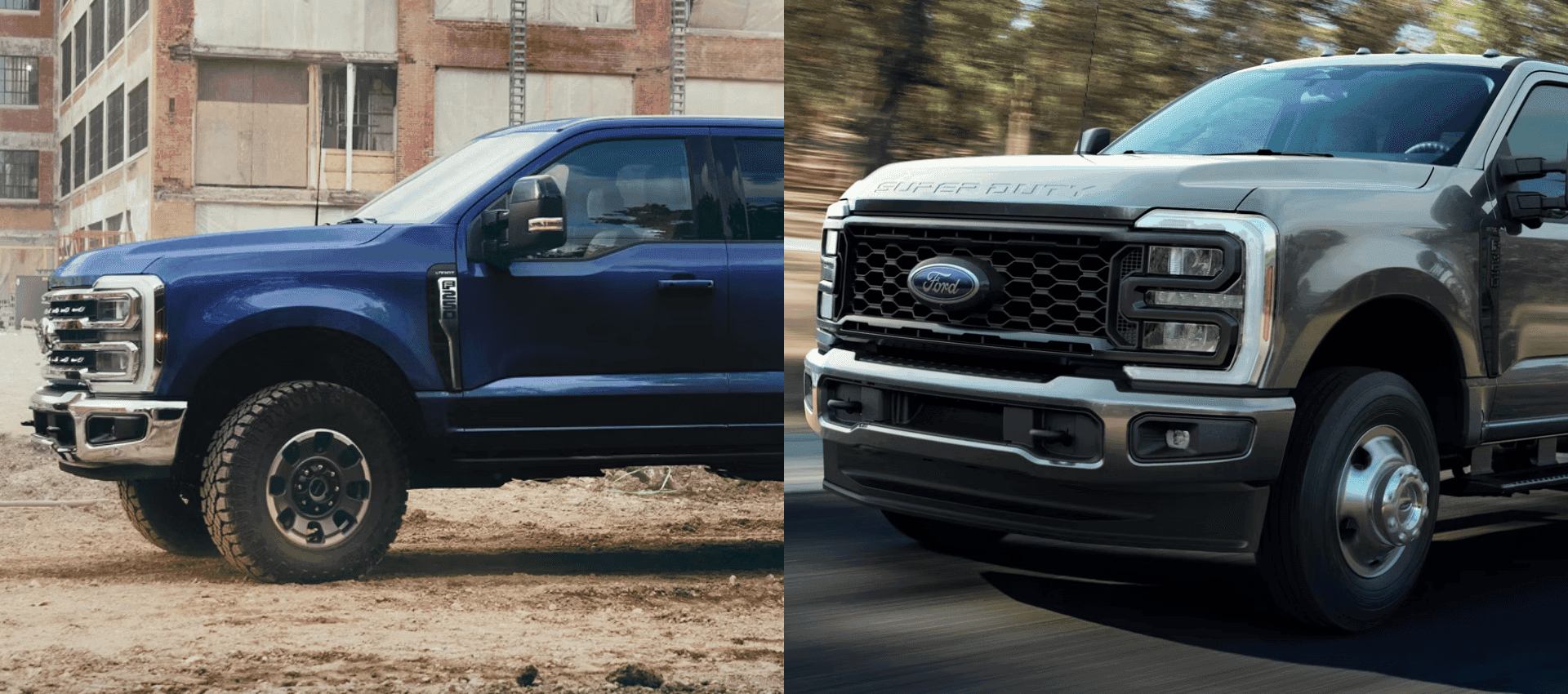
The 2026 F-250 and F-350 share cabs, beds, and engines — the difference is capacity and rear-axle setup. Rob Sight Ford in Kansas City stocks both, including SRW and DRW F-350 configurations, for side-by-side comparison.
Engine Options: Identical Power, Different Missions
Here’s the part that surprises many buyers: the F-250 and F-350 offer the exact same engines. Your powertrain decision is independent of which truck you pick, so you can spec a base F-250 with the biggest diesel or an F-350 with the standard gas V8. All four engines pair with Ford’s 10-speed TorqShift automatic, tuned to keep each one in its most efficient torque band. If you want a half-ton instead, the lighter-duty Ford F-150 covers everyday hauling — but for serious towing, these Super Duty V8s are the story.
6.8L Gas V8 (Standard)
405 horsepower and 445 lb-ft of torque on regular fuel. The value choice for lighter, in-town work and fleets that prioritize a lower purchase price over maximum towing muscle.
7.3L “Godzilla” Gas V8
430 horsepower and 485 lb-ft, still on regular fuel. A big-displacement gas engine that delivers strong towing without the diesel price premium — popular for fleets that tow moderately but rack up miles.
6.7L Power Stroke Diesel
475 horsepower and a massive 1,050 lb-ft of torque. The go-to for frequent heavy towing, where diesel torque and long-haul efficiency pay back the higher upfront cost.
6.7L High-Output Power Stroke
A best-in-class 500 horsepower and 1,200 lb-ft of torque. Built for maximum gooseneck and fifth-wheel loads — most at home in an F-350 that’s regularly working near the top of its rating.
| Engine | Horsepower | Torque | Transmission |
|---|---|---|---|
| 6.8L Gas V8 | 405 hp | 445 lb-ft | 10-Speed TorqShift |
| 7.3L “Godzilla” Gas V8 | 430 hp | 485 lb-ft | 10-Speed TorqShift |
| 6.7L Power Stroke Diesel | 475 hp | 1,050 lb-ft | 10-Speed TorqShift |
| 6.7L High-Output Diesel | 500 hp | 1,200 lb-ft | 10-Speed TorqShift |
Because the engines are shared, the smarter way to think about it is: pick the truck for its capacity, then pick the engine for how hard and how far you tow. A landscaper towing a dump trailer in town may be perfectly happy with a gas V8, while a contractor pulling a loaded gooseneck to job sites will earn back the diesel premium in torque and fuel efficiency under load.
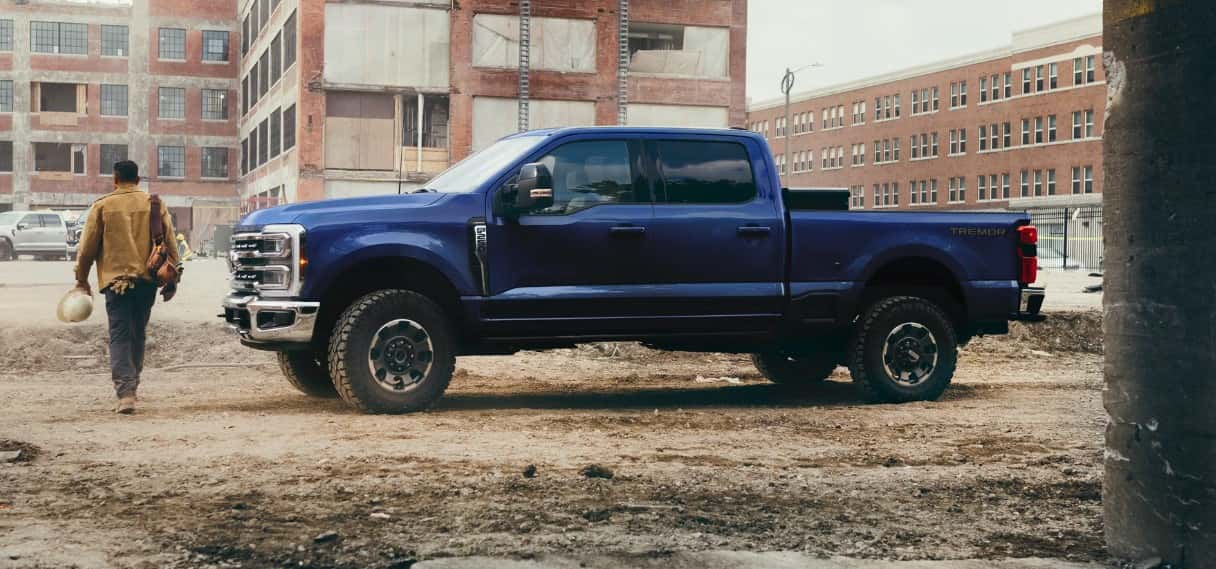
Both the F-250 and F-350 offer the same four V8 engines, topping out at 500 HP and 1,200 lb-ft with the High-Output Power Stroke diesel. Rob Sight Ford in Kansas City can help you match the engine to your towing and mileage profile.
Towing and Payload: Where the Real Difference Lives
This is the heart of the F-250 vs. F-350 decision. Both are seriously capable, but the F-350 — especially in DRW form — pulls ahead where it counts most for heavy-duty businesses. Keep in mind that maximum figures require a specific combination of cab, bed, engine, and axle ratio, so always verify the exact configuration. Here’s how the two trucks stack up at the top of their ranges:
| Capability | F-250 | F-350 |
|---|---|---|
| Max Towing (Properly Equipped) | Up to ~23,000 lbs | Up to ~38,000 lbs |
| Max Payload | Up to ~4,246 lbs | Up to ~8,000 lbs (DRW) |
| Rear-Wheel Options | SRW only | SRW or DRW |
| Max Available Torque | 1,200 lb-ft | 1,200 lb-ft |
| Ideal Role | Comfort plus real capability | Maximum work capacity |
Single Rear Wheel vs. Dual Rear Wheel (SRW vs. DRW)
Since DRW is the F-350’s headline advantage, it’s worth understanding exactly what those extra tires buy you — and what they cost. Dual rear wheels widen the rear track for a more planted, stable feel under heavy gooseneck and fifth-wheel loads, and they raise payload significantly. The trade-offs are width, tighter parking, and two extra tires to replace.
| Feature | Single Rear Wheel (SRW) | Dual Rear Wheel (DRW) |
|---|---|---|
| Payload Capacity | Lower | Highest in the lineup |
| Stability Under Gooseneck Loads | Good | Best |
| Parking & Maneuverability | Easier, narrower | Wider, needs more room |
| Tire Replacement | Four tires | Six tires |
| Best For | Mixed daily use plus towing | Car haulers, flatbeds, large RVs |
For most trades and service businesses that occasionally run near the top of their weight, an F-350 SRW hits the sweet spot — more payload than an F-250 while still parking and driving like a normal pickup. Reserve the DRW for operations that genuinely live at the heavy end: hauling equipment, running a flatbed or dump body, or towing large gooseneck trailers as a core part of the job.
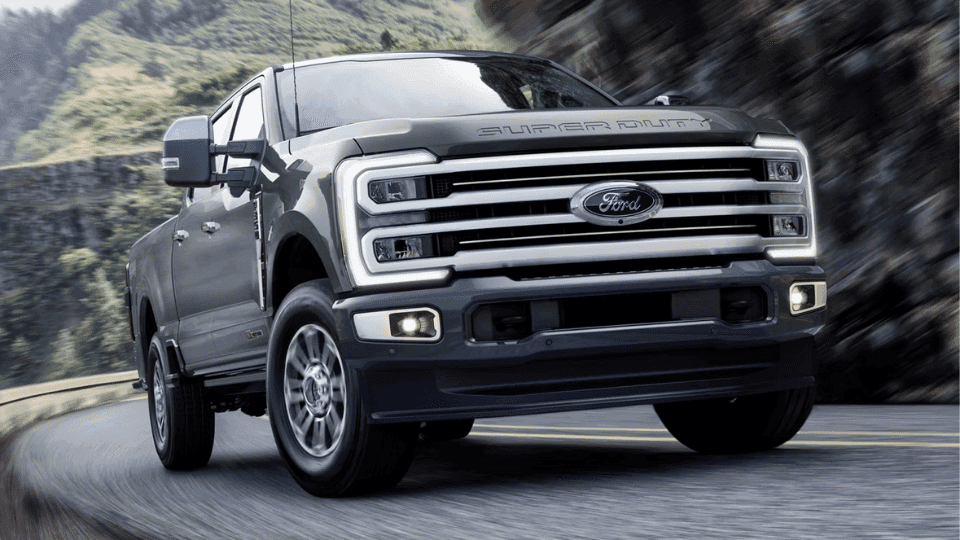
The F-350’s dual-rear-wheel option unlocks maximum payload and the most stability under heavy gooseneck and fifth-wheel loads. Rob Sight Ford in Kansas City stocks SRW and DRW configurations to test drive under real-world conditions.
Factors Beyond the Spec Sheet That Decide the Right Truck
The Details That Shape Daily Ownership
Peak towing and payload numbers make the headlines, but the truck you drive every day is shaped by ride quality, size, licensing, and running cost. These are the practical factors that often tip a close decision one way or the other:
Ride & Comfort
Empty, the F-250’s lighter-duty springs deliver a smoother ride, while the F-350’s stiffer setup feels firmer unladen but settles under load. If the truck doubles as a daily driver, the F-250 is usually the more livable choice.
Maneuverability & Parking
An SRW truck fits standard spaces, garages, and tight job sites more easily. A DRW F-350 is noticeably wider at the rear, so consider where the truck lives and works before committing to duals.
GVWR & Licensing
Higher-rated F-350 builds can push gross combined weight into territory that affects registration and, in some commercial cases, licensing. Confirm the rules for how your business will use and load the truck.
Fuel & Running Cost
A lighter F-250 with a gas V8 is cheaper to run for in-town work; a diesel F-350 pulling heavy loads is more efficient under weight. Match the powertrain and truck to your true duty cycle, not the maximum you might ever do.
| Factor | Impact on the Decision | Guidance |
|---|---|---|
| Unladen ride quality | F-250 softer, F-350 firmer | Pick F-250 if it doubles as a daily driver |
| Payload headroom | F-350 far higher | Don’t run an F-250 near its limit — step up |
| GVWR & licensing | Higher on heavy F-350 builds | Confirm commercial rules for your use |
| Maneuverability | DRW is wider at the rear | Choose SRW for tight sites and garages |
| Fuel & tire cost | DRW and diesel cost more to run | Right-size to avoid overspending |
Technology and Towing Features That Earn Their Keep
Both trucks share the same suite of work-focused technology, so you don’t have to move up to an F-350 to get the smart features. For a business, these tools translate directly into safer towing, less downtime, and easier daily operation — and several are available across the trim range.
Pro Power Onboard
Available onboard power turns the truck into a mobile generator for tools, lights, and equipment on the job site — reducing the need to haul a separate generator and keeping crews productive.
Advanced Trailering Tech
Features like Pro Trailer Hitch Assist, Trailer Reverse Guidance, and onboard scales with Smart Hitch help drivers connect, load, and back up heavy trailers safely — a real advantage for less-experienced operators.
Ford Co-Pilot360
Standard driver-assist features add a safety margin for big trucks in traffic, helping protect both the crew and the significant investment the vehicle represents for the business.
Ford Pro Telematics
Connected fleet software adds GPS tracking, health alerts, and maintenance reminders. Eligible 2026 models include a complimentary one-year trial — valuable whether you run one Super Duty or ten.
| Feature | Availability | Business Benefit |
|---|---|---|
| Pro Power Onboard | Available | Runs tools without a separate generator |
| Pro Trailer Hitch Assist | Available | Faster, safer hookups and backing |
| Ford Co-Pilot360 | Standard driver-assist | Added safety margin in traffic |
| Ford Pro Telematics | 1-year trial (eligible 2026 models) | Tracking, uptime, and maintenance alerts |
Because these features are shared across F-250 and F-350, technology shouldn’t drive your model choice — capacity should. Spec the smart features you’ll actually use on whichever truck fits your loads, and let the capability decision stand on its own.
How the Super Duty Compares — and What It Costs to Run
The Super Duty competes hard against the Ram 2500/3500 and the Chevrolet Silverado and GMC Sierra HD twins. Ford’s advantage in this class is the combination of best-in-class available diesel output and its broad range of cab, bed, and axle configurations. The competitor figures below are approximate top-of-range numbers for context — always confirm current specs — but they show where the F-350 leads:
| One-Ton Truck | Approx. Max Tow | Approx. Max Payload | Top Diesel Output |
|---|---|---|---|
| Ford F-350 Super Duty | ~38,000 lbs | ~8,000 lbs | 500 hp / 1,200 lb-ft |
| Ram 3500 HD | ~36,600 lbs | ~7,590 lbs | Cummins ~1,075 lb-ft |
| Chevrolet Silverado 3500HD | ~36,000 lbs | ~7,290 lbs | Duramax ~975 lb-ft |
| GMC Sierra 3500HD | ~36,000 lbs | ~7,290 lbs | Duramax ~975 lb-ft |
The class is tightly contested, but Ford’s top diesel torque and configuration flexibility keep the F-350 at or near the front for heavy-duty work. Just as important for a business is the local support behind the truck — parts availability, service capacity, and commercial expertise all factor into real ownership cost.
Estimated Annual Fuel Cost (15,000 Miles/Year)
Because the Super Duty exceeds 8,500 lbs GVWR, it’s exempt from EPA fuel-economy ratings, so the figures below are real-world estimates for planning — diesel at $4.00/gal and gas at $3.50/gal. Your actual numbers depend heavily on load and towing:
| Configuration | Est. Real-World MPG | Est. Annual Fuel Cost |
|---|---|---|
| F-250 Diesel (6.7L) | ~18 mpg | ~$3,333 |
| F-250 Gas (6.8L) | ~14 mpg | ~$3,750 |
| F-350 SRW Diesel | ~16 mpg | ~$3,750 |
| F-350 DRW Diesel | ~14 mpg | ~$4,286 |
The spread shows why over-buying capacity costs you every year, not just at purchase. Business buyers should also note that many Super Duty work trucks may qualify for significant first-year write-offs. See our guide on Section 179 deductions for the Ford Super Duty to understand how that applies to your purchase.
Making the Final Call: Which Super Duty Fits Your Business?
The cleanest way to decide is to start from your heaviest regular job and work backward. Match the truck to the loads you actually pull and carry on a typical week — not the once-a-year extreme — and the answer usually becomes obvious. Here’s how common Kansas City business scenarios map to the lineup:
| Business Scenario | Recommended Truck | Why |
|---|---|---|
| Occasional towing, daily driving | F-250 | Comfort and efficiency with real capability |
| Frequent heavy towing, same footprint | F-350 SRW | More payload while still parking like an F-250 |
| Car hauler, flatbed, or dump body | F-350 DRW | Maximum payload and load stability |
| Large gooseneck or fifth-wheel RV | F-350 DRW | Headroom for the heaviest towing |
| Landscaping or service body | F-350 SRW | Payload for equipment without full DRW width |
If your loads are genuinely light and you rarely tow heavy, it’s worth asking whether you need a Super Duty at all — a half-ton pickup may save you money up front and at the pump. But the moment payload or heavy trailering becomes a regular part of the job, the F-250 or F-350 is the right tool. Explore the broader Ford commercial truck inventory to see how the Super Duty fits alongside the rest of the work-vehicle lineup.
Still on the fence? The fastest way to decide is to drive both back to back with a representative load. Our commercial team can set that up and help you spec the exact cab, bed, engine, and axle for the work you do — so you buy once and buy right.
Tips for Choosing and Buying the Right Super Duty
A little discipline at buying time keeps you from overspending or overloading. These tips apply whether you’re adding one truck or building out a fleet:
Match the Truck to the Trailer
Know your trailer’s loaded weight and hitch type before you shop. Gooseneck and fifth-wheel loads point toward an F-350; lighter bumper-pull trailers may be fine on an F-250.
Don’t Overload an F-250
If your typical load lands near the F-250’s payload ceiling, step up to an F-350. Running at the limit wears the truck faster and can put you over your legal weight rating.
Choose DRW Only If You Need It
Duals add payload and stability but also width and tire cost. If you’re not regularly at max weight, an F-350 SRW gives most of the capability with easier daily use.
Do the Diesel vs. Gas Math
Diesel earns its premium with frequent heavy towing and high mileage. For lighter, lower-mileage in-town work, a gas V8 often wins on total cost. Run your real numbers before deciding.
Compare the F-250 and F-350 at Rob Sight Ford in Kansas City
Whether you’re outfitting a trade business, hauling equipment, or towing heavy trailers, Rob Sight Ford in Kansas City has the Super Duty inventory and the commercial expertise to help you choose between the F-250 and F-350 with confidence. We serve businesses throughout the Kansas City metro — including Overland Park, Lee’s Summit, Independence, and Liberty — and our commercial team is fluent in every Super Duty cab, bed, engine, and axle configuration available.
Call us at 816-895-6901, apply for financing before you arrive, or reach out to schedule a back-to-back test drive of both trucks.
Frequently Asked Questions
What is the main difference between the 2026 Ford F-250 and F-350?
The biggest difference is towing and payload capacity. The 2026 F-250 tows up to about 23,000 lbs and carries a max payload near 4,246 lbs, while the F-350 tows up to about 38,000 lbs with a gooseneck and carries up to 8,000 lbs of payload. The F-350 is also available with dual rear wheels (DRW), which the F-250 is not. Cabs, beds, and engines are shared between the two.
Do the 2026 Ford F-250 and F-350 have the same engines?
Yes. Both trucks share the same four V8 engines: a standard 6.8L gas V8 (405 hp), an available 7.3L “Godzilla” gas V8 (430 hp), a 6.7L Power Stroke turbo diesel (475 hp, 1,050 lb-ft), and a 6.7L High-Output Power Stroke diesel (500 hp, 1,200 lb-ft). All four pair with Ford’s 10-speed TorqShift automatic transmission.
How much can the 2026 Ford F-250 and F-350 tow?
When properly equipped, the 2026 F-250 tows up to approximately 23,000 lbs and the F-350 tows up to approximately 38,000 lbs with a gooseneck or fifth-wheel hitch. Actual capacity depends on cab, bed, engine, axle ratio, and whether the truck is a single or dual rear wheel model, so always confirm the door-jamb and towing-guide numbers for the specific configuration.
Should my business choose an F-350 SRW or DRW?
Choose dual rear wheels (DRW) when you need maximum payload and the most stability under heavy gooseneck, flatbed, or fifth-wheel loads — think car haulers, dump beds, and large RVs. Choose single rear wheels (SRW) when you want strong capability with easier parking, lower tire cost, and a truck that still works as a daily driver. Most businesses that only occasionally run at max weight are well served by an SRW.
Is the F-250 or F-350 better for daily driving?
The F-250 generally rides more comfortably when unladen and is easier to maneuver and park, which makes it the better everyday driver for crews that tow occasionally. The F-350 is built to carry and pull more, so its suspension feels firmer empty but stays composed under heavy loads. If your truck spends more time hauling than commuting, the F-350’s extra capability is worth the trade-off.
0 comment(s) so far on 2026 Ford F-250 vs. F-350: Which Super Duty Is Right for Your Business?