

Ford F-450 & F-550 Specs: Medium-Duty Commercial Trucks for Kansas City
Ford F-450 & F-550 Super Duty Specs in Kansas City
A trim-by-trim, engine-by-engine breakdown of Ford’s two heaviest Super Duty trucks — the dually F-450 pickup and the upfit-ready F-550 chassis cab — built for Kansas City contractors, haulers, and fleets that have outgrown an F-350
Once a job outgrows an F-350, the next step up in Ford’s Super Duty lineup splits into two very different trucks. The F-450 stays a pickup — a dually with an 8-foot bed built for businesses and drivers who need serious towing muscle but still want a factory truck bed underfoot. The F-550 drops the bed entirely and ships as a bare chassis cab, a rolling frame designed from the start to carry whatever commercial body an upfitter bolts on. Both are built on the same Super Duty platform, but they’re aimed at different jobs, and picking the right one shapes everything from the engine you’ll run to how the truck gets titled. For the full towing and payload breakdown across the entire lineup, our Super Duty towing capacity chart compares the F-250 through the F-550 side by side.
This guide focuses on what makes the F-450 and F-550 different from each other and from the rest of the Super Duty family — trim levels, engine certification quirks, wheelbase and cab options, and the upfit bodies that turn an F-550 chassis into a working truck. If you already know you need a Super Duty and just want current inventory, browse what’s on our lot while you read.
Key Takeaways
- The F-450 is pickup-only — a diesel dually with an 8-foot bed — while the F-550 is sold exclusively as a bare chassis cab for commercial upfits.
- F-450 trims run XL, XLT, Lariat, King Ranch, and Platinum; F-550 trims are simpler — XL, XLT, and Lariat (Lariat available only on Crew Cab).
- The F-550’s standard 7.3L gas V8 makes 335 hp/468 lb-ft and its optional 6.7L Power Stroke diesel makes 330 hp/950 lb-ft — lower peak numbers than the same-displacement engines in an F-450 pickup because the chassis cab is certified differently.
- F-550 chassis are available in eight wheelbase lengths from 145 to 205 inches to match whatever body gets installed.
- A well-equipped F-450 tows up to 40,000 lbs on a gooseneck; a well-equipped F-550 chassis can be built to ~37,000 lbs GVWR before a body is even added.
- Every Ford purchase or lease at Rob Sight Ford includes our standing offer of $100 below invoice pricing on all Ford vehicles except specialty units.
F-450 vs. F-550 — At a Glance
Body Styles: Pickup (F-450) & Chassis Cab (F-550) | Trims: Up to 5 (F-450) / 3 (F-550) | Wheelbases: 2 (F-450) / 8 (F-550) | Standing Offer: $100 Below Invoice
What Sets the F-450 and F-550 Apart in Ford’s Super Duty Lineup
Both trucks share the same Super Duty frame, cab architecture, and TorqShift 10-speed automatic transmission, but Ford builds them for different end points. The F-450 rolls off the line as a complete pickup — dual rear wheels, an 8-foot box, diesel-only power — ready to drive off the lot. The F-550 rolls off as an incomplete vehicle: a cab, a frame, and a chassis, with no body at all until a second-stage manufacturer or upfitter finishes it into a dump truck, flatbed, service rig, or whatever the job calls for.
That difference in how each truck is certified matters more than it might seem. Because the F-550 is finished by an upfitter rather than sold complete, its engines are tuned and emissions-certified differently than the same-displacement engines in an F-250, F-350, or F-450 pickup — which is exactly why the horsepower and torque numbers below look lower on paper even though the physical engine blocks are the same size.
F-450 vs. F-550 Side-by-Side
| Feature | Ford F-450 | Ford F-550 |
|---|---|---|
| Body Style | Dually pickup, 8-ft bed | Bare chassis cab, upfit required |
| Trims | XL, XLT, Lariat, King Ranch, Platinum | XL, XLT, Lariat |
| Engine Options | Diesel only (2 Power Stroke variants) | Gas standard, diesel optional |
| Cab Choices | Regular Cab, Crew Cab | Regular Cab, SuperCab, Crew Cab |
| Wheelbase Options | 2 (141.5″ or 175.9″) | 8 (145″ to 205″) |
| Best For | Heavy towing with a truck bed still needed | Vocational bodies — dump, flatbed, service, more |
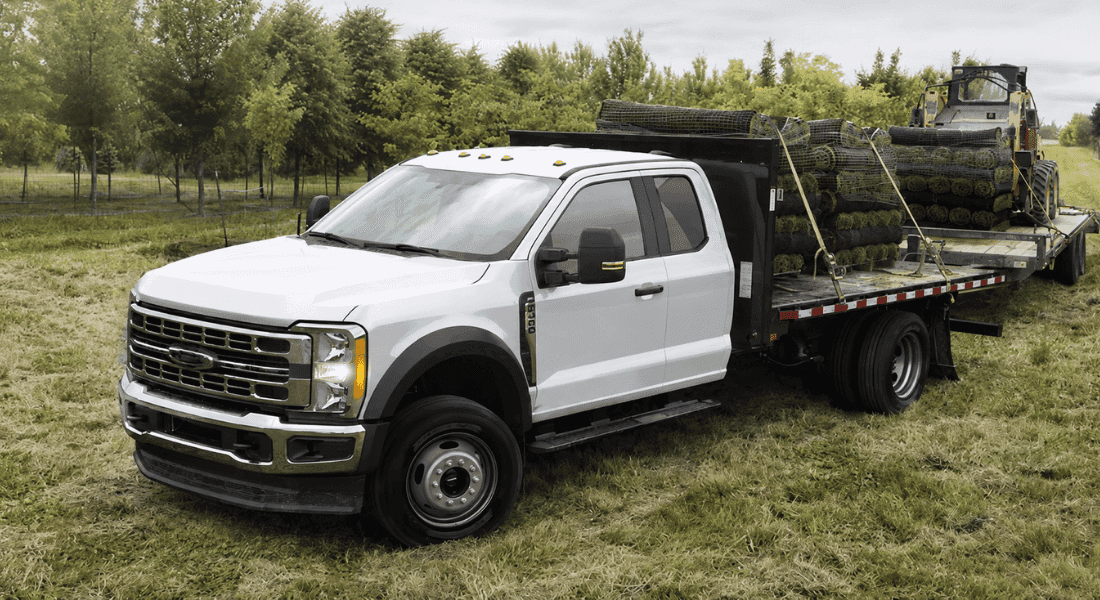
The F-450 keeps its factory bed for businesses that need Super Duty towing muscle without giving up a truck bed for tools, materials, and gear.
2026 Ford F-450 Specs: Trims, Engine, and Configurations
The F-450 is the heaviest pickup Ford builds, and it’s diesel-only across every trim — there’s no gas option, since the whole truck is engineered around towing and payload rather than fuel-cost flexibility. Every F-450 comes standard with the 6.7L Power Stroke V8 Turbo Diesel making 475 hp and 1,050 lb-ft of torque, with the 6.7L High-Output Power Stroke available as a roughly $3,500 upgrade that raises output to 500 hp and 1,200 lb-ft. Both pair with the 10-speed TorqShift automatic transmission and a 4.30 limited-slip rear axle standard.
Buyers choose between a Regular Cab on a 141.5-inch wheelbase (seats 3) or a Crew Cab on a 175.9-inch wheelbase (seats 6), both with the same 8-foot dually bed and a choice of 4×2 or 4×4 drivetrain. Trim levels run from the fleet-oriented XL through XLT, Lariat, King Ranch, and Platinum, with pricing starting around $62,330 for an XL Regular Cab and climbing past $96,000 for a loaded Platinum Crew Cab. A properly configured F-450 can tow up to 40,000 lbs on a gooseneck or fifth-wheel hitch, with payload landing in the 5,300 to 6,300-lb range depending on cab, axle, and options.
Standard 6.7L Power Stroke
475 hp and 1,050 lb-ft of torque, included on every F-450 trim from XL through Platinum.
Optional 6.7L HO Power Stroke
500 hp and 1,200 lb-ft of torque, the same upgrade offered on the F-250 and F-350.
Regular Cab
141.5-inch wheelbase, seats 3, the lighter and more maneuverable of the two cab choices.
Crew Cab
175.9-inch wheelbase, seats 6, the choice for crews that need to travel to and from the job site together.
2026 Ford F-550 Super Duty Specs: Chassis, Engine, and Wheelbase Options
The F-550 is Ford’s entry point into true medium-duty chassis-cab territory, and it’s built to be finished, not driven straight off the lot. It comes standard with a 7.3L gas V8 rated at 335 hp and 468 lb-ft of torque — a chassis-cab-certified tune of the same “Godzilla” engine used elsewhere in the lineup — with a 6.7L Power Stroke Turbo Diesel available as an upgrade, rated at 330 hp and 950 lb-ft. Both run through the 10-speed TorqShift automatic, and both numbers land lower than you’d expect from an F-450 pickup’s Power Stroke simply because the F-550 is certified as an incomplete chassis vehicle rather than a finished truck.
Where the F-550 really separates itself is configuration flexibility. Buyers choose from Regular Cab, SuperCab, or Crew Cab (Lariat trim is Crew Cab only), then pick from eight wheelbase lengths spanning 145 to 205 inches so the frame length matches whatever body is going on top. GVWR climbs with the axle and suspension package ordered, reaching roughly 37,000 lbs at the top end — well into Class 5 territory and pushing toward Class 6 depending on how the truck is configured. Chassis pricing generally starts in the neighborhood of $59,000 to $60,000 before the upfit body is added, since that final cost depends entirely on which body goes on.
F-550 Wheelbase & Cab Options
| Cab Style | Available Trims | Typical Use |
|---|---|---|
| Regular Cab | XL, XLT | Maximum frame length for long flatbeds and dump bodies |
| SuperCab | XL, XLT | Extra storage or a jump seat without a full crew cab |
| Crew Cab | XL, XLT, Lariat | Crew transport alongside a service or utility body |
For a deeper look at how the 6.7L Power Stroke performs across the Super Duty lineup, including the pickup-tuned ratings, see our 6.7 Power Stroke specs guide.
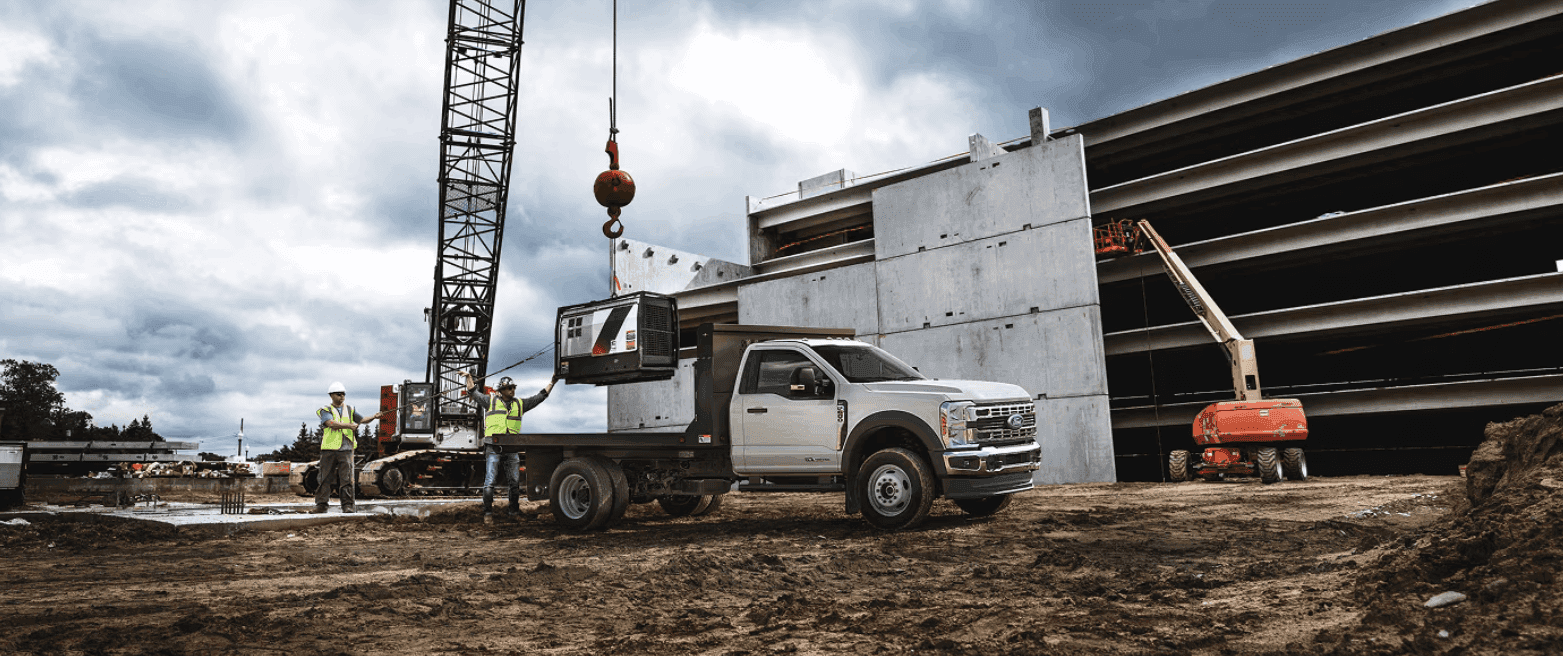
An F-550 chassis leaves the factory as a blank slate — the wheelbase and GVWR package you choose determine which upfit bodies will fit.
Upfit Bodies and Vocational Use Cases for the F-550 Chassis Cab
Because the F-550 leaves the factory without a body, the real shape of the finished truck comes from the upfitter. Ford’s chassis-cab platform is designed to accept a wide range of second-stage bodies, and matching the right one to your GVWR package and wheelbase is the difference between a truck that handles the job easily and one that’s overloaded from day one.
Flatbed & Stake Bodies
Open, load-from-any-side platforms favored by construction and material-hauling businesses that move lumber, pipe, or equipment.
Dump Bodies
Hydraulic-lift beds for hauling and dumping gravel, dirt, mulch, and debris — a common landscaping and excavation configuration.
Service & Mechanic Bodies
Enclosed compartments, drawers, and sometimes a crane, built for mobile repair techs, utility crews, and equipment maintenance.
Landscape Bodies
Low-side beds with ramps for hauling mowers, mulch, and crews from job to job across the Kansas City area.
Tow & Wrecker Bodies
Rollback and wheel-lift setups for towing operators, built around the F-550’s high GVWR and available diesel torque.
Box Bodies, Snowplows & Emergency Builds
Enclosed cargo boxes for delivery routes, front-mount snowplow setups for winter operations, and specialty emergency-vehicle conversions.
For businesses weighing whether an F-550 upfit or a broader Ford Pro fleet strategy makes more sense, our Ford Pro commercial fleet buying guide covers the full ecosystem of vehicles, telematics, and financing available to Kansas City businesses.
Which Super Duty Fits Your Business — F-350, F-450, or F-550?
Not every business that thinks it needs an F-450 or F-550 actually does. Towing and payload needs, not truck size alone, should drive the decision — and stepping up to a heavier truck than necessary usually means paying more for capability you’ll never use.
| Business Need | Recommended Truck | Why |
|---|---|---|
| Heavy towing, still wants a truck bed | F-450 | Highest towing pickup Ford builds, without giving up cargo bed space |
| Needs a dump, flatbed, or service body | F-550 | Only Super Duty sold as a chassis cab ready for upfit bodies |
| Frequent daily driving, lighter towing | F-250 or F-350 | Lower cost of entry and easier everyday maneuverability |
| Undecided between two similar options | Compare towing needs first | Right-sizing saves on fuel and purchase price long-term |
If you’re comparing a lighter Super Duty against these two heavier trucks, our F-250 vs. F-350 business comparison is a useful starting point before you size all the way up to an F-450 or F-550.
F-450 & F-550 Pricing and Tax Considerations for 2026
Both trucks carry a real cost beyond the sticker price. An F-450 XL Regular Cab starts around $62,330 and climbs from there with trim and options, while an F-550 chassis typically starts in the $59,000 to $60,000 range before any upfit body is added — and that body can add anywhere from a few thousand dollars for a basic flatbed to well over $20,000 for a specialized dump or crane setup.
On the tax side, both the F-450 and F-550 comfortably clear the IRS’s 6,000-lb GVWR threshold for accelerated Section 179 depreciation, since both sit well above 14,000 lbs GVWR. That generally makes a much larger first-year deduction available than on a typical car or light SUV, though the exact amount depends on your business income, how the truck is used, and how any upfit body affects the numbers. Our Super Duty Section 179 guide walks through the current limits in more detail — it’s worth reviewing with your accountant before you finalize a purchase.
Tips for Choosing Between an F-450 and F-550 in Kansas City
A little planning before you configure either truck can save real money and prevent an expensive reconfiguration down the road:
Pick the Body Before the Chassis
On an F-550, wheelbase and GVWR package should be chosen around the specific upfit body you plan to install, not the other way around.
Don’t Overbuy Towing Capacity
If your heaviest trailer never approaches F-450 territory, an F-350 may cost less to buy and run without sacrificing real-world capability.
Ask About Gas vs. Diesel on the F-550
The standard 7.3L gas V8 costs less upfront and can suit lighter-duty upfits, while the diesel option makes sense for heavier bodies and frequent towing.
Loop In Your CPA on Section 179
Confirm how an upfit body affects your deduction calculation before you finalize the purchase, since the body cost factors into the total.
Find Your F-450 or F-550 Super Duty at Rob Sight Ford
Whether you need a dually pickup that can still haul a full trailer or a bare chassis ready for your upfitter, our commercial team can walk you through F-450 and F-550 configurations side by side and help you land on the right engine, cab, and wheelbase for the job. Every deal includes our standing offer of $100 below invoice pricing on Ford vehicles.
Call us at 816-895-6901 to speak with a commercial vehicle specialist, browse our current Super Duty inventory, or apply for financing before you arrive. Serving Kansas City, Overland Park, Lee’s Summit, Grandview, Blue Springs, and the surrounding area.
Frequently Asked Questions
What’s the actual difference between a Ford F-450 and an F-550?
The biggest difference is body style and mission. The F-450 is sold exclusively as a dual-rear-wheel pickup with an 8-foot bed, built diesel-only for businesses and individuals who need serious towing muscle but still want a factory truck bed. The F-550 is sold exclusively as a chassis cab — there’s no bed at all, just a frame behind the cab ready for an upfitter to bolt on a flatbed, dump body, service body, or other commercial equipment. The F-550 also offers a gas engine option the F-450 doesn’t, plus a much wider range of wheelbase lengths (145 to 205 inches) to match whatever body gets installed.
Can I get a Ford F-450 as a chassis cab instead of a pickup?
No — as of the current Super Duty generation, Ford builds the F-450 only as a dually pickup with a factory 8-foot bed. If your business needs a cab-and-chassis platform for a flatbed, dump body, or other upfit, the F-550 is Ford’s entry point into that configuration, and it scales up from there into the F-600 and medium-duty F-650.
What upfit bodies can go on an F-550 chassis cab?
The F-550’s cab-and-chassis design is built to accept nearly any commercial body an upfitter offers, including flatbeds, dump bodies, stake beds, service and mechanic bodies, landscape bodies, tow and wrecker bodies, box bodies, snowplow setups, and emergency vehicle conversions. Which one fits best depends on the GVWR package, wheelbase, and axle ratio ordered on the chassis, so it’s worth talking through the intended body with our commercial team before you configure the truck.
How much can an F-450 or F-550 tow and haul?
A properly equipped F-450 can tow up to 40,000 lbs on a gooseneck or fifth-wheel hitch and up to roughly 30,000 lbs conventionally, with a payload around 5,300 to 6,300 lbs depending on cab and axle configuration. The F-550 chassis cab is rated for roughly 20,000 lbs conventional and up to about 34,300 lbs on a gooseneck, with payload capacity that can climb past 12,000 lbs once you factor in the upgraded axle and suspension packages available at higher GVWR ratings. Exact numbers shift with engine, cab, wheelbase, and body weight, so our full Super Duty towing capacity chart is the best place to check a specific configuration.
Do I need a CDL to drive a Ford F-550 in Missouri or Kansas?
Not necessarily. Federal rules generally require a commercial driver’s license once a truck’s GVWR — or a truck-and-trailer combination’s GCWR — crosses 26,001 lbs, and a heavily upfitted F-550 can approach or exceed that threshold on its own before a trailer is even attached. Both Missouri and Kansas offer exemptions for certain non-commercial and farm uses, but the rules depend on how the truck is titled and used, so it’s worth confirming your specific configuration and use case with your state’s motor vehicle division before you count on driving CDL-free.
0 comment(s) so far on Ford F-450 & F-550 Specs: Medium-Duty Commercial Trucks for Kansas City