

2026 Bronco Sport vs Toyota RAV4: Which SUV is Right for You?
2026 Ford Bronco Sport vs Toyota RAV4
The complete head-to-head comparison — capability, efficiency, tech, safety, and value for Kansas City drivers
Two of the most popular compact SUVs on the market today take fundamentally different approaches to what a compact SUV should be. The 2026 Ford Bronco Sport vs Toyota RAV4 debate comes down to this: do you want a vehicle engineered from the ground up for adventure, or a refined daily driver optimized for efficiency and cargo space? At Rob Sight Ford in Kansas City, MO, we help shoppers make this call every week — and the right answer depends entirely on how you actually use your vehicle.
This guide covers every dimension that matters — off-road capability, performance, interior space, tech, safety, fuel economy, and total ownership cost — with honest numbers on both sides. Whether you’re commuting on I-435, hauling gear to the Lake of the Ozarks, or running kids to school in Johnson County, the right SUV is in here.
Key Takeaways
- The Bronco Sport includes standard 4×4 on every trim — the RAV4 starts with front-wheel drive and charges extra for AWD
- The RAV4 wins on fuel economy, especially in hybrid form at up to 40 mpg combined vs. the Bronco Sport’s 23–27 mpg
- The Bronco Sport scores 88/100 on J.D. Power reliability — the RAV4 scores 80/100
- The RAV4 has more raw cargo volume (69.8 cu ft max vs. 65.2 cu ft); the Bronco Sport’s boxy shape is more useful for bulky outdoor gear
- The Bronco Sport’s 13.2″ SYNC 4 touchscreen with wireless CarPlay is standard on every trim; the RAV4 base gets a 7″ screen
- For serious off-road capability, the Bronco Sport’s G.O.A.T. Modes, Trail Control, and Badlands hardware have no real RAV4 equivalent
Quick Answer: Which Should You Buy?
Choose the Bronco Sport if you want standard 4×4, trail-ready capability, superior off-road technology, and a vehicle that handles Kansas City winters with purpose-built hardware. Choose the RAV4 if maximum fuel economy (especially hybrid) and raw cargo volume are your top priorities and you rarely venture off pavement.
Bronco Sport Max Ground Clearance
Bronco Sport G.O.A.T. Modes (Badlands)
Bronco Sport J.D. Power Score (vs. RAV4’s 80)
RAV4 Hybrid MPG Combined
HP — Bronco Sport Badlands 2.0L EcoBoost
Bronco Sport SYNC 4 Screen — Standard All Trims
Off-Road & All-Weather Capability
This is where the two vehicles diverge most sharply. The Bronco Sport was engineered specifically as a trail-capable compact SUV — every design decision from the upright roofline to the skid plates flows from that mission. The RAV4 is a well-equipped crossover that handles light off-pavement use and all-weather driving with competence, but without the purpose-built hardware the Bronco Sport carries standard.
Bronco Sport: Purpose-Built 4×4
Every Bronco Sport trim ships with true driver-selectable 4×4 — not reactive all-wheel drive. The G.O.A.T. (Goes Over Any Type of Terrain) Modes system adjusts throttle mapping, transmission shift points, and traction control simultaneously for the selected surface. All five standard modes — Normal, Eco, Sport, Slippery, and Sand — are available from the base Big Bend. The Badlands adds Rock Crawl and Mud/Ruts for seven total, along with an electronic locking rear differential, Bilstein dampers, HOSS 3.0 suspension, steel-plated bumpers, bash plates, and Goodyear Territory All-Terrain tires. Ground clearance reaches 8.8 inches. Water fording depth hits 23.6 inches. Trail Control holds 1–20 mph off-road cruise control automatically. For the full breakdown of the Bronco Sport’s trail hardware, see our Bronco Sport off-road capabilities guide.
RAV4: Capable Crossover, Light Trail Use
The RAV4’s Dynamic Torque Vectoring AWD system is genuinely useful — it monitors conditions and distributes up to 50% of power to the rear axle when needed, and can independently vector torque between rear wheels for cornering stability. It handles dirt roads, gravel, moderate snow, and the kinds of terrain most Kansas City drivers encounter confidently. The Adventure and TRD Off-Road trims reach 8.6 inches of ground clearance with specialized tuning. But the RAV4 doesn’t have Trail Control, a terrain mode dial, a locking differential, or water fording depth ratings — and it doesn’t come standard with AWD on any trim. For all-pavement and light gravel driving, the RAV4’s system is more than sufficient. For serious trail work, it isn’t in the same class as the Badlands.
| Capability | 2026 Ford Bronco Sport | Toyota RAV4 |
|---|---|---|
| Standard Drivetrain | True 4×4 — all trims | Front-wheel drive standard; AWD optional (~$1,400) |
| Max Ground Clearance | 8.8 inches (Badlands) | 8.6 inches (Adventure / TRD) |
| Terrain Modes | 5–7 G.O.A.T. Modes (all trims) | 3 Multi-Terrain Select modes (select trims only) |
| Trail Control | Yes — 1–20 mph off-road cruise control | No |
| Locking Rear Differential | Yes (Badlands) | No |
| Water Fording Depth | 23.6 inches (rated) | Not rated |
| Max Towing | 2,700 lbs (equipped) | 3,500 lbs (gas, equipped) |
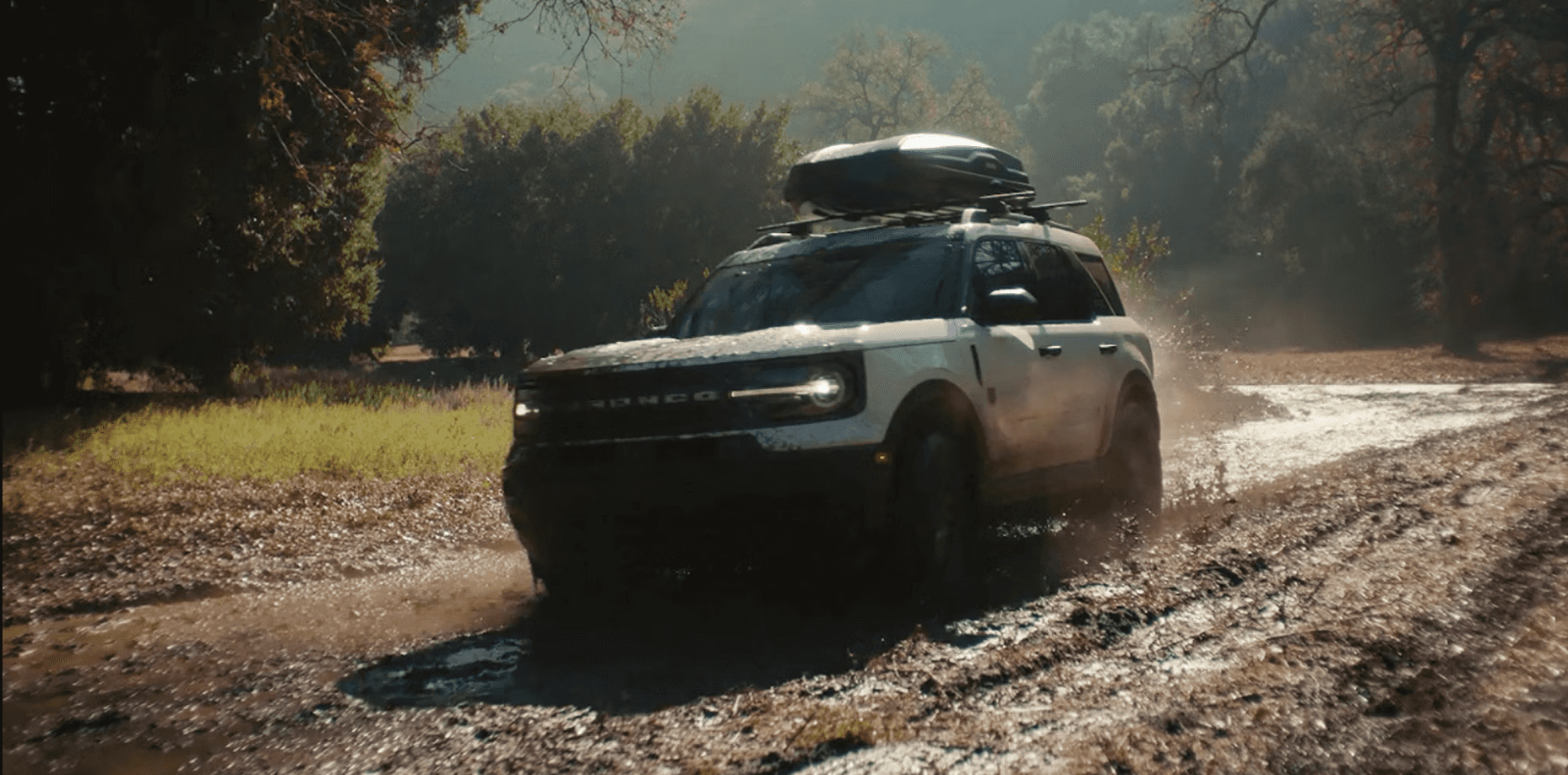
The 2026 Ford Bronco Sport Badlands is purpose-built for trail use — G.O.A.T. Modes, Trail Control, locking rear diff, and 8.8 inches of clearance are features the RAV4 simply doesn’t offer
Performance & Powertrain
Both vehicles offer multiple powertrain options, but they’re tuned toward different priorities. The Bronco Sport emphasizes low-end torque and turbocharged response useful for off-road traction and confident highway passing. The RAV4 prioritizes smooth, linear power delivery for daily commuting comfort — with hybrid options that add meaningful efficiency without sacrificing capability.
Bronco Sport Engines
The base 1.5L EcoBoost three-cylinder produces 181 hp and 200 lb-ft of torque — enough for daily driving, highway merges, and light trail use. It achieves approximately 26–27 mpg combined and runs on regular unleaded. The 2.0L EcoBoost four-cylinder on the Badlands delivers 250 hp and 280 lb-ft of torque, hitting 60 mph in 5.9 seconds — genuinely quick for this class. Both engines pair with an 8-speed automatic and both run on regular gas, saving money at every fill-up.
RAV4 Engines
The standard 2.5L four-cylinder makes 203 hp with smooth, predictable power delivery — refined and well-suited to the RAV4’s daily-driver character. The RAV4 Hybrid combines the 2.5L with electric motors for 219–236 hp system output and around 40 mpg combined — noticeably more efficient than any Bronco Sport configuration. The RAV4 Prime plug-in hybrid reaches 302 hp and 5.7 seconds to 60 mph, with 42–50 miles of electric-only range. The Prime is impressive on paper but harder to find in Kansas City inventory and carries a significant price premium over the base RAV4.
| Model | Horsepower | Torque | 0–60 MPH | MPG Combined |
|---|---|---|---|---|
| Bronco Sport 1.5L EcoBoost | 181 hp | 200 lb-ft | 8.2 sec | 26–27 mpg |
| Bronco Sport 2.0L EcoBoost (Badlands) | 250 hp | 280 lb-ft | 5.9 sec | 23 mpg |
| RAV4 2.5L Gas | 203 hp | 184 lb-ft | 8.6 sec | 30 mpg |
| RAV4 Hybrid AWD | 236 hp | Combined system | 7.0 sec | 40 mpg |
| RAV4 Prime Plug-In Hybrid | 302 hp | Combined system | 5.7 sec | 38 mpg + electric |
Interior, Cargo & Dimensions
Both SUVs seat five, but they use the space differently. The Bronco Sport’s boxy, upright roofline delivers more headroom and a higher seating position — both improve driver visibility and rear-seat comfort for taller adults. The RAV4 wins on raw cargo numbers but its tapered rear profile makes loading bulky gear less practical than the Bronco Sport’s squared-off bay.
Bronco Sport Cargo Strengths
32.5 cu ft behind rear seats / 65.2 cu ft maximum. Rubberized, washable cargo floor. MOLLE seatback straps for trail gear. Flip-up rear glass for quick access. Double-floor hidden storage compartment. Boxy shape loads camping gear, bikes, and coolers without the geometry puzzle of tapered crossovers.
RAV4 Cargo Strengths
37.6 cu ft behind rear seats / 69.8 cu ft maximum — about 5 cu ft more than the Bronco Sport in both configurations. Low lift-over height eases heavy loads. Available hands-free liftgate. Hidden floor compartment. Traditional carpet flooring feels premium for grocery runs and family trips.
| Spec | 2026 Ford Bronco Sport | Toyota RAV4 |
|---|---|---|
| Overall Length | 172.7 inches | 180.5 inches |
| Height | 71.5 inches | 67.0–69.0 inches |
| Cargo (Seats Up) | 32.5 cu ft | 37.6 cu ft |
| Cargo (Max) | 65.2 cu ft | 69.8 cu ft |
| Front Legroom | More generous | Adequate |
| Cargo Floor Material | Rubberized, washable | Traditional carpet |
| Special Storage | MOLLE straps, double-floor, fold-out table | Hidden floor compartment, deep door pockets |
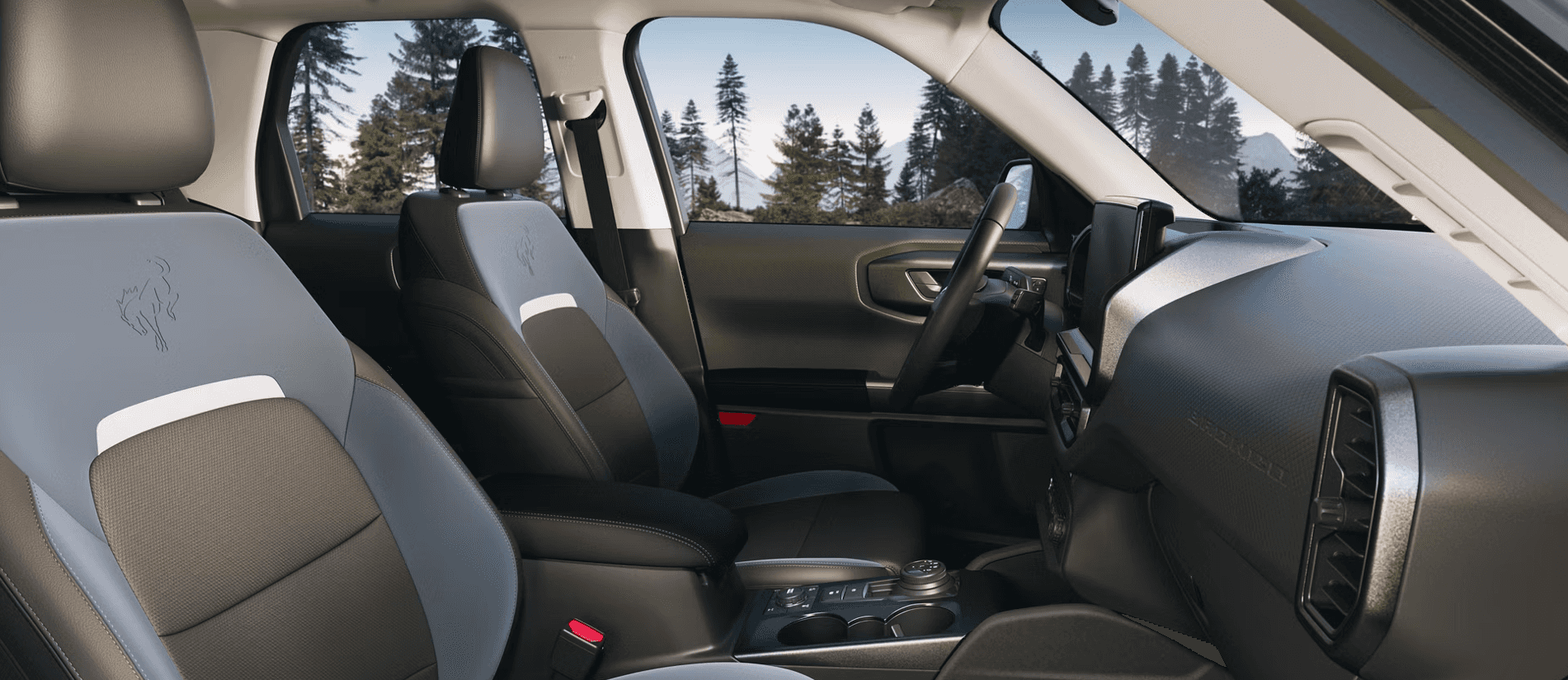
The Bronco Sport’s interior is built for active use — rubberized flooring, MOLLE straps, and adventure-ready materials versus the RAV4’s traditional soft-touch approach
Technology, Safety & Reliability
The Bronco Sport holds a significant technology advantage at the base trim level. Every Bronco Sport — including the entry Big Bend — ships with a 13.2-inch SYNC 4 touchscreen with wireless Apple CarPlay and Android Auto, split-screen capability, and FordPass Connect. The base RAV4 LE gets a 7-inch display, and wireless smartphone integration requires stepping up to higher trims. Both vehicles include comprehensive standard safety suites at no extra cost.
Ford Co-Pilot360 (Standard — All Trims)
Pre-Collision Assist with Automatic Emergency Braking, Blind Spot Information System, Lane-Keeping System, Adaptive Cruise Control, Rear Cross-Traffic Alert, Auto High-Beam Headlamps. All standard on every Bronco Sport trim — no packages required.
Toyota Safety Sense 2.5+ (Standard — All Trims)
Pre-Collision System, Dynamic Radar Cruise Control, Lane Departure Alert with Lane Tracing Assist, Road Sign Assist, Automatic High Beams. Comparable coverage to Co-Pilot360 — both are genuinely comprehensive standard safety suites.
| Feature | 2026 Ford Bronco Sport | Toyota RAV4 |
|---|---|---|
| Standard Screen Size | 13.2″ SYNC 4 — all trims | 7″ base; 8–10.5″ upper trims |
| Wireless CarPlay / Android Auto | Standard — all trims | Available upper trims only |
| Premium Audio | Bang & Olufsen (available) | JBL (available) |
| NHTSA Overall Rating | 5 Stars | 5 Stars |
| J.D. Power Quality Score | 88/100 — “Great” | 80/100 — “Average” |
| Roadside Assistance | 5 years / 60,000 miles | 2 years / 25,000 miles |
| Bumper-to-Bumper Warranty | 3 years / 36,000 miles | 3 years / 36,000 miles |
| Powertrain Warranty | 5 years / 60,000 miles | 5 years / 60,000 miles |
Price, Trims & Value Comparison
The RAV4 has a lower starting price, but that number requires context. The base LE starts around $31,250 — without AWD. Adding AWD costs roughly $1,400 more. The Bronco Sport Big Bend starts at $33,690 with 4×4, a 13.2-inch screen, and roof rails already included. At equivalent capability levels, the price gap closes significantly — and the Bronco Sport delivers more standard technology for the money. For Bronco Sport towing package pricing and configurations, Rob Sight Ford can walk you through current options and incentives.
| Trim Level | Starting Price | Key Standard Features | Best For |
|---|---|---|---|
| Bronco Sport Base / Big Bend | ~$31,500 / ~$33,690 | 4×4, 13.2″ SYNC 4, G.O.A.T. Modes, skid plates | Adventure-capable daily drivers |
| Bronco Sport Outer Banks | ~$37,800 | Heated leather seats, power adjust, HOSS 2.0 | Comfort + trail capability balance |
| Bronco Sport Badlands | ~$40,500 | 2.0L EcoBoost, 7 G.O.A.T. Modes, locking diff, Bilstein, AT tires | Serious trail enthusiasts |
| RAV4 LE / XLE | $31,250–$33,500 (+$1,400 for AWD) | Safety Sense, 7″ screen, FWD standard | Efficiency-focused commuters |
| RAV4 Hybrid | ~$33,000–$40,000 | 40 mpg, standard AWD, electric motor assist | High-mileage commuters, fuel savers |
| RAV4 Prime | $43,000–$48,000+ | 302 hp, 42–50 mi electric range, plug-in hybrid | Tech adopters, short-commute EV drivers |
Annual Fuel Cost Comparison
Based on 12,000 miles/year and $3.50/gallon regular unleaded in the Kansas City area:
| Vehicle | Combined MPG | Annual Fuel Cost | 5-Year Fuel Cost |
|---|---|---|---|
| Bronco Sport 1.5L | 26–27 mpg | ~$1,556–$1,615 | ~$7,780–$8,075 |
| Bronco Sport 2.0L (Badlands) | 23 mpg | ~$1,826 | ~$9,130 |
| RAV4 Gas AWD | 30 mpg | ~$1,400 | ~$7,000 |
| RAV4 Hybrid FWD | 40 mpg | ~$1,050 | ~$5,250 |
Compare the Bronco Sport and RAV4 at Rob Sight Ford in Kansas City
The best way to settle the Bronco Sport vs RAV4 debate is to drive both. At Rob Sight Ford in Kansas City, MO, we stock the full Bronco Sport lineup — Big Bend, Heritage, Outer Banks, and Badlands — so you can experience the G.O.A.T. Modes dial, the 13.2-inch SYNC 4 screen, and the difference between HOSS 1.0 and HOSS 3.0 suspension firsthand. Our team includes drivers who use these vehicles off-road and can answer real-world questions about trail performance, towing, and winter driving on Missouri roads.
We offer transparent pricing, competitive financing, and fair trade-in valuations — no pressure, no hidden fees. Call us at 816-895-6901 or stop by our Kansas City showroom to explore current inventory and schedule your test drive.
Frequently Asked Questions
Which SUV has better off-road capability — the 2026 Ford Bronco Sport or the Toyota RAV4?
The 2026 Ford Bronco Sport is the clear winner. Every trim comes standard with true 4×4, up to 8.8 inches of ground clearance, and five to seven G.O.A.T. terrain management modes. The Badlands adds an electronic locking rear differential, bash plates, all-terrain tires, and Trail Control. The RAV4 handles light gravel and snowy roads well but isn’t engineered for serious trail use the way the Bronco Sport is.
How does the fuel economy compare between the Bronco Sport and RAV4?
The Toyota RAV4 leads on fuel efficiency — the hybrid achieves up to 40 mpg combined versus the Bronco Sport’s 23–27 mpg. However, the Bronco Sport runs on regular unleaded gasoline, typically 30–50 cents cheaper per gallon than premium. The RAV4 saves on fuel volume; the Bronco Sport delivers standard 4×4 that no RAV4 trim includes without an upcharge.
What is the towing capacity of the 2026 Bronco Sport vs Toyota RAV4?
The 2026 Ford Bronco Sport tows up to 2,700 pounds when properly equipped — handling small campers, boat trailers for Lake of the Ozarks weekends, and utility trailers with ease. The gas-only RAV4 is rated up to 3,500 pounds on certain trims. For full Bronco Sport towing package details, Rob Sight Ford in Kansas City can walk you through available Missouri-ready configurations.
Which compact SUV has better reliability ratings?
The 2026 Ford Bronco Sport scores 88 out of 100 in J.D. Power’s Quality and Reliability survey — rated “Great.” The Toyota RAV4 scores 80 out of 100 — rated “Average.” While Toyota has a long reliability reputation, Ford has made significant quality improvements in recent years, and the Bronco Sport’s score reflects fewer owner-reported problems in the first years of ownership.
How do the starting prices compare between the Bronco Sport and RAV4?
The RAV4 starts around $31,250, but AWD adds roughly $1,400 extra. The Bronco Sport Big Bend starts at $33,690 with 4×4, a 13.2-inch SYNC 4 screen, and roof rails already standard. At equivalent capability levels the price gap narrows significantly, and the Bronco Sport delivers more included technology for the money.
Which SUV handles Kansas City winter weather better?
The 2026 Ford Bronco Sport has the edge for Kansas City winters. Standard 4×4 across every trim and a dedicated Slippery G.O.A.T. Mode calibrate the drivetrain specifically for ice and snow before wheels start spinning. The RAV4 handles winter competently with available AWD, but the Bronco Sport’s purpose-built 4×4 system and terrain modes give it a meaningful advantage in severe conditions.
0 comment(s) so far on 2026 Bronco Sport vs Toyota RAV4: Which SUV is Right for You?